

By now, many homeowners are aware that polyurethane injection is an economical
and highly effective repair method for basement leak and foundation crack
sealing; instead of digging up your home. On this page we cover what matters
most to homeowners.
- The usefulness of polyurethane injection for foundation crack sealing
- How polyurethane injection works
- Video of a high pressure polyurethane crack injection
- Types of leaks fixed by injecting polyurethane
- Images of typical problems fixed by polyurethane injection
- The attributes of polyurethane (PU) resin
The usefulness of polyurethane injection for foundation crack sealing
This type of foundation crack injection (sometimes referred to as urethane
injection) is arguably the most common type of injection used for repairing
basement leaks and waterstopping generally, due to its versatility. It is used
exclusively for stopping leaks in poured concrete foundation walls, ceiling
slabs and other structures. When waterstopping is required in subway tunnels
and mineshafts, the cracks and rock fissures are injected under high pressure
with polyurethane (also referred to as grout) — so you know this crack repair
method works under real-life conditions.
It should be noted that in some instances
epoxy crack injection
is the preferred choice to repair foundation cracks; particularly foundation
settlement cracks.
How polyurethane injection works
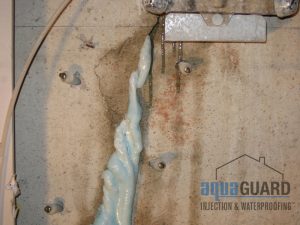
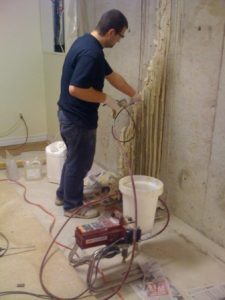
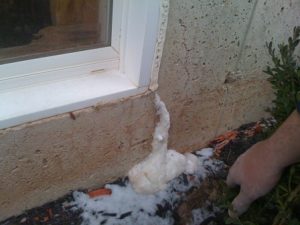
Polyurethane injection involves the pressurized injection of activated
polyurethane resin through injection packers hammered into drilled holes into
poured concrete basement foundation walls. This injected resin travels through
the entire thickness of the foundation wall (typically 8″). Within the crack
the polyurethane expands and solidifies within the cavity thereby eliminating
the cavity and preventing water from leaking into your basement.
Note: Polyurethane can also be injected at a lower pressure
using a process virtually identical to that used for epoxy crack injections.
Video of a high pressure polyurethane crack injection
Watch how we inject a leaking foundation crack from inside using high pressure polyurethane.
Types of leaks fixed by the injection of polyurethane
- Actively leaking cracks in poured concrete foundations;
- Foundation crack sealing of wet or damp basement walls;
-
Previously repaired cracks (internally and/or externally) that are leaking.
Note: an epoxy injection is not appropriate for repairing a failed crack injection. - Cracks full of mud or mineral deposits;
-
Cracks caused by corroding reinforcing bars (typically in reinforced
concrete slabs in underground parking garages); - Leaking forming tie-rod holes;
- Leaking forming snap rods;
- Leaking underground structures in general (such as parking garage cracks and seams);
-
Underground pipe penetrations in a wall for electrical conduits, gas lines,
air conditioning lines and pipes; - Honeycombing;
- The bottom of swimming pools (when the underside is accessible);
- Seams created by a cold pour; and
- Overhead concrete structures.
Wondering how much a crack injection costs?
Find out now!
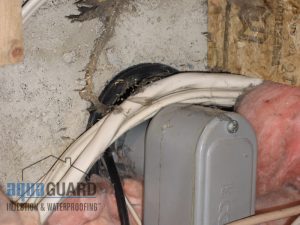
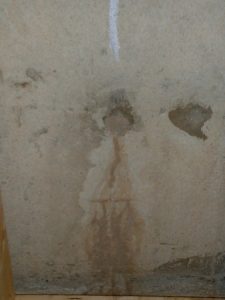
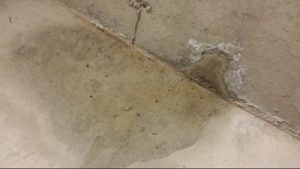
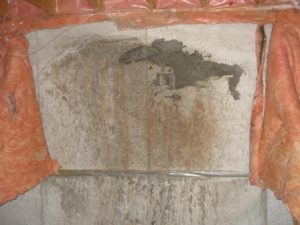
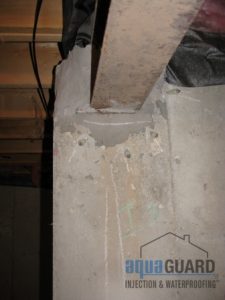
Images of typical problems fixed by polyurethane injection
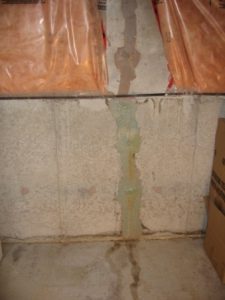
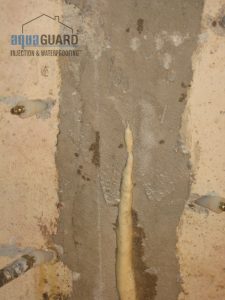
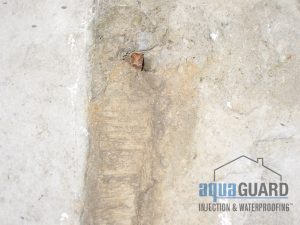
If any of the images below match your situation, polyurethane injection is a viable and cost-effective solution for you.
The attributes of polyurethane (PU) resin
From reviewing the typical applications above, it is clear that polyurethane
injection is an extremely versatile waterproofing method that can be used to
deal with any basement leak in a poured concrete structure, under all
conditions. This versatility is attributable to the characteristics of our
polyurethane resins which are:
-
Our activated polyurethane typically expands to 2.5 times its volume; this
is very desirable when filling large cavities or when the size of a cavity
is unknown (as in the case of honeycombing); -
The expansive force of polyurethane is significant; consequently, it will
fill any and all gaps that it encounters – this is particularly useful when
foundation crack sealing of very porous concrete or when dealing with
honeycombing. It will also expand wherever it can; following the path of
least resistance, it will fill any and all voids encountered; -
Some polyurethane resins are non-toxic; this makes them suitable for use
with potable water systems such as cisterns; -
Polyurethane sets rapidly in the presence of hydrogen. Since hydrogen
molecules are a component of water (H2O), the presence of water
during an injection actually increases the reactivity of the polyurethane.
This makes polyurethane the ideal product to use when active basement leaks
and/or significant hydrostatic pressure are encountered; -
The polyurethane resins that we use will not freeze and always remain
flexible (not an attribute of all polyurethanes). This is desirable when the
concrete surrounding it expands and contracts due to thermal cycling; -
Polyurethane sets very quickly – this is essential in stopping leaks where
significant hydrostatic pressure is present; -
High pressure polyurethane injections employ hydraulic hoses which are
crucial when accessibility to the repair area is limited; and -
At AquaGuard Injection & Waterproofing® we adjust the viscosity of our
polyurethane resin; this gives us the ability to deal with any underground
leak situation, from hairline cracks to large voids.
Note 1: Several technical factors need to be taken into
account to determine whether a basement leak should be injected using
epoxy
or polyurethane. For example, the effects of tension and compression at the
crack location must be factored into the decision on how best to deal with
your leak repair. There is a lot of science behind injection repairs; trust
our trained technicians to determine whether polyurethane injection is optimal
for your circumstances.
Note 2: Not all Waterproofing Contractors offer high pressure
polyurethane injection basement leak waterproofing repairs. Why? Because it
takes training, skill, knowledge, high quality polyurethane formulations,
professional injection equipment and determination to perform a successful
polyurethane injection; otherwise the injection will likely fail. As
significant training and a commitment to work excellence is crucial, many
companies shy away from polyurethane injections because they cannot reliably
produce successful results. The demanding nature of polyurethane injection is
so significant that some of our competitors call upon us to perform their
warranty repairs!
Want more information on how foundation cracks are injected? Call us today!