

Basement Leak Diagnosis: How to Find the True Source of Water in Your Basement
Discovering water in your basement can be frustrating. Whether you have water on the floor, a leaking foundation crack, wet drywall, mold or damaged flooring or water appearing from behind a finished wall, the first question is always the same:
“Where is the water coming from?”
Unfortunately, the answer is not always obvious. Water can enter through a foundation crack, a leaking tie-rod hole, around a basement window, over the top of the foundation wall or from another part of the building envelope. In some cases, the source is hidden behind insulation or finished walls, making diagnosis even more challenging.
After more than 24 years of inspecting and repairing basement leaks, AquaGuard Injection has found that many homeowners are encouraged to make expensive repair decisions before the true source of the water has been confirmed. While comprehensive foundation waterproofing may sometimes be the right solution, it is not the only solution.
AquaGuard Injection believes homeowners should understand the true source of a basement leak before deciding on a repair. Understanding and proving what is actually happening is the key to determining the best repair and course of action.
This guide has been written to help homeowners recognize the most common signs of basement leaks, understand what those signs may mean and learn how experienced leak investigations are carried out. It is not intended to replace a professional inspection, but to help you better understand your basement before deciding what to do next.
The following sections begin with the most common homeowner observations and work progressively through the most frequent causes of basement leaks, explaining what to look for, what the evidence may suggest and when further investigation may be appropriate.
There Is Water on My Basement Floor
Finding water on your basement floor is the most common reason homeowners contact AquaGuard Injection. Although the water is easy to see, the place where it has collected is not always where it entered the basement.
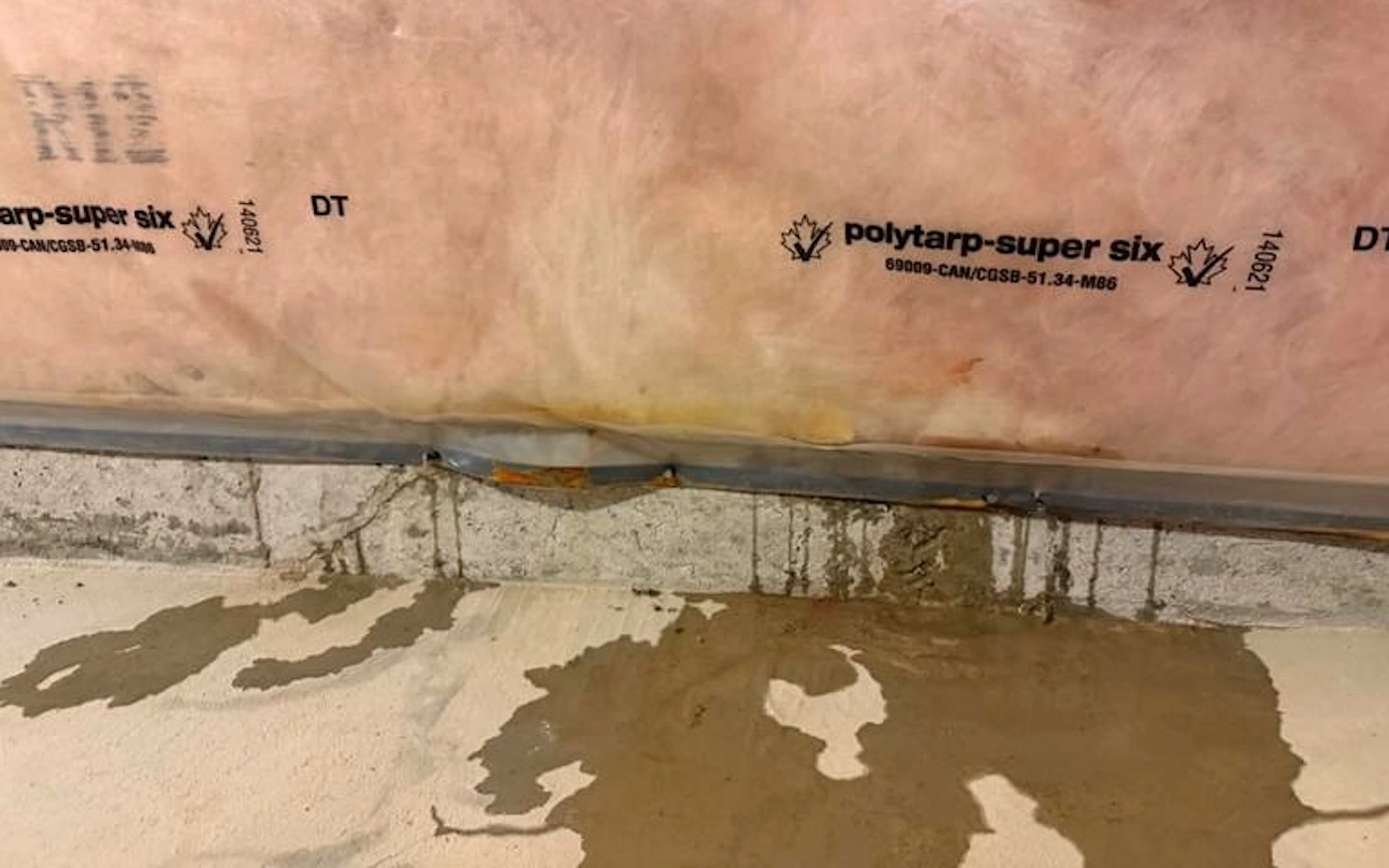
Start Where the Water Is Found
The first step is to carefully inspect the area where the water has collected. In our experience, the source of the leak is often found nearby, making this the best place to begin the investigation.
Although water can travel across a basement floor, it usually does not travel very far before becoming visible. For that reason, we begin our investigation where the water is first observed.
Look for damp concrete, staining, foundation cracks, leaking holes, moisture behind insulation, water around basement windows or signs that water has entered over the top of the foundation wall.
Water on the Floor Doesn’t Mean the Water Came Up Through the Floor
Water found on the basement floor does not necessarily mean the water came up through the floor. It may have entered through the foundation wall, around a basement window, over the top of the foundation wall, behind insulation or from another concealed location before eventually collecting on the floor. In some situations, the water really is entering from beneath the floor, but that should never be assumed without evidence. See Water Seems to Be Coming Up Through My Basement Floor.
Understanding What Is Happening
A successful repair begins with understanding how the water entered the basement. Sometimes the cause is obvious. In other situations, additional investigation is needed before the source can be confirmed.
It is also important to remember that more than one leak may be present. Repairing one leak does not necessarily mean another leak does not exist nearby. If the source cannot be confirmed, see I Don’t Know Where the Water Is Coming From.
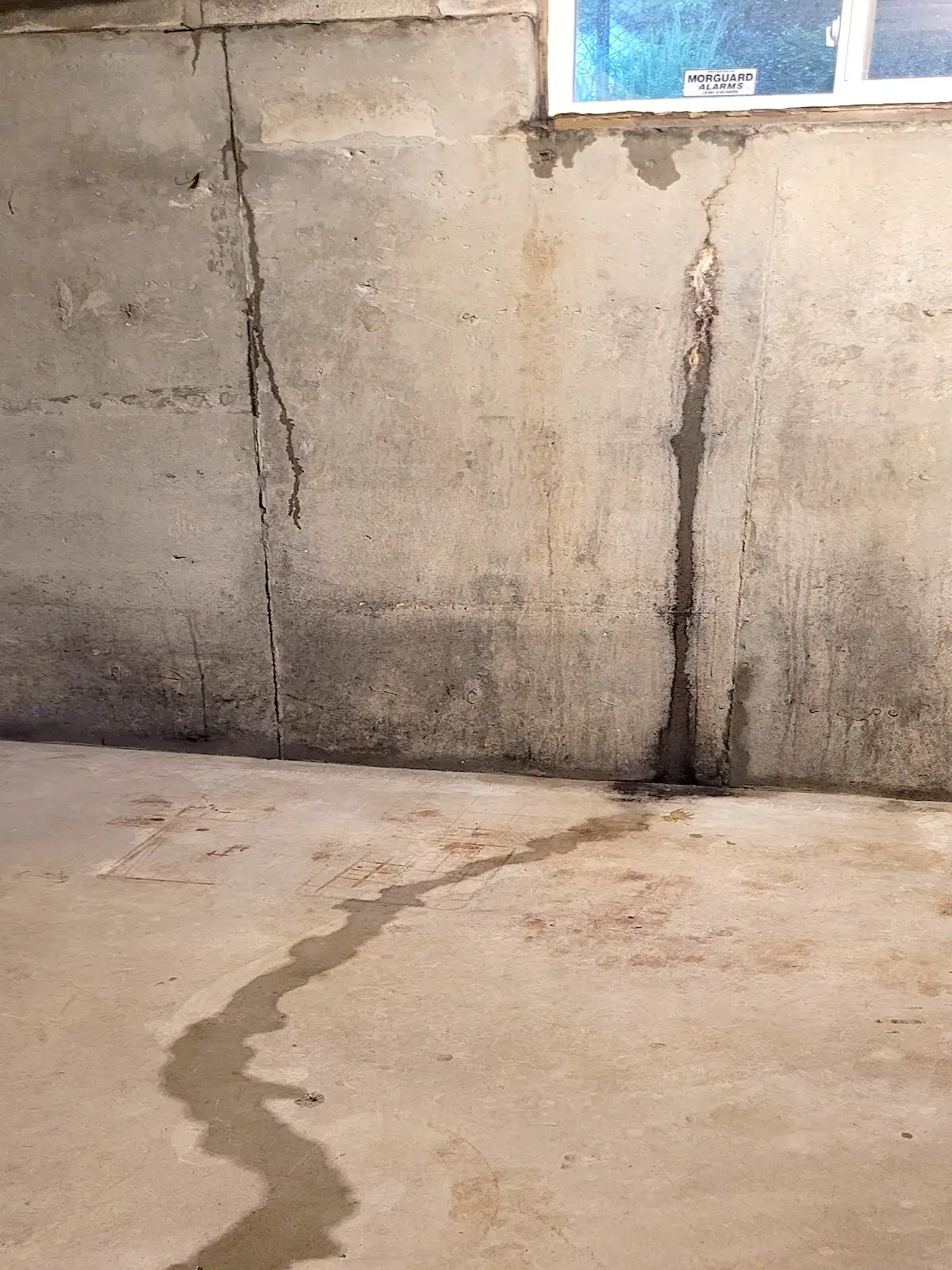
Our Recommendation
AquaGuard Injection believes homeowners should understand the true source of a basement leak before deciding on a repair. Before recommending any waterproofing solution, we first identify and confirm the true source of the water.
Understanding and proving what is actually happening is the key to determining the best repair and course of action.
Water Is Coming From Behind the Insulation or Finished Wall
Water appearing from behind insulation or a finished basement wall can be difficult to diagnose because the foundation wall is hidden from view. However, after more than 24 years of experience, AquaGuard Injection has found that the problem is usually located close to where the water is first observed.
That is where the investigation should begin. It is also important to remember that more than one leak may be present in the same area.
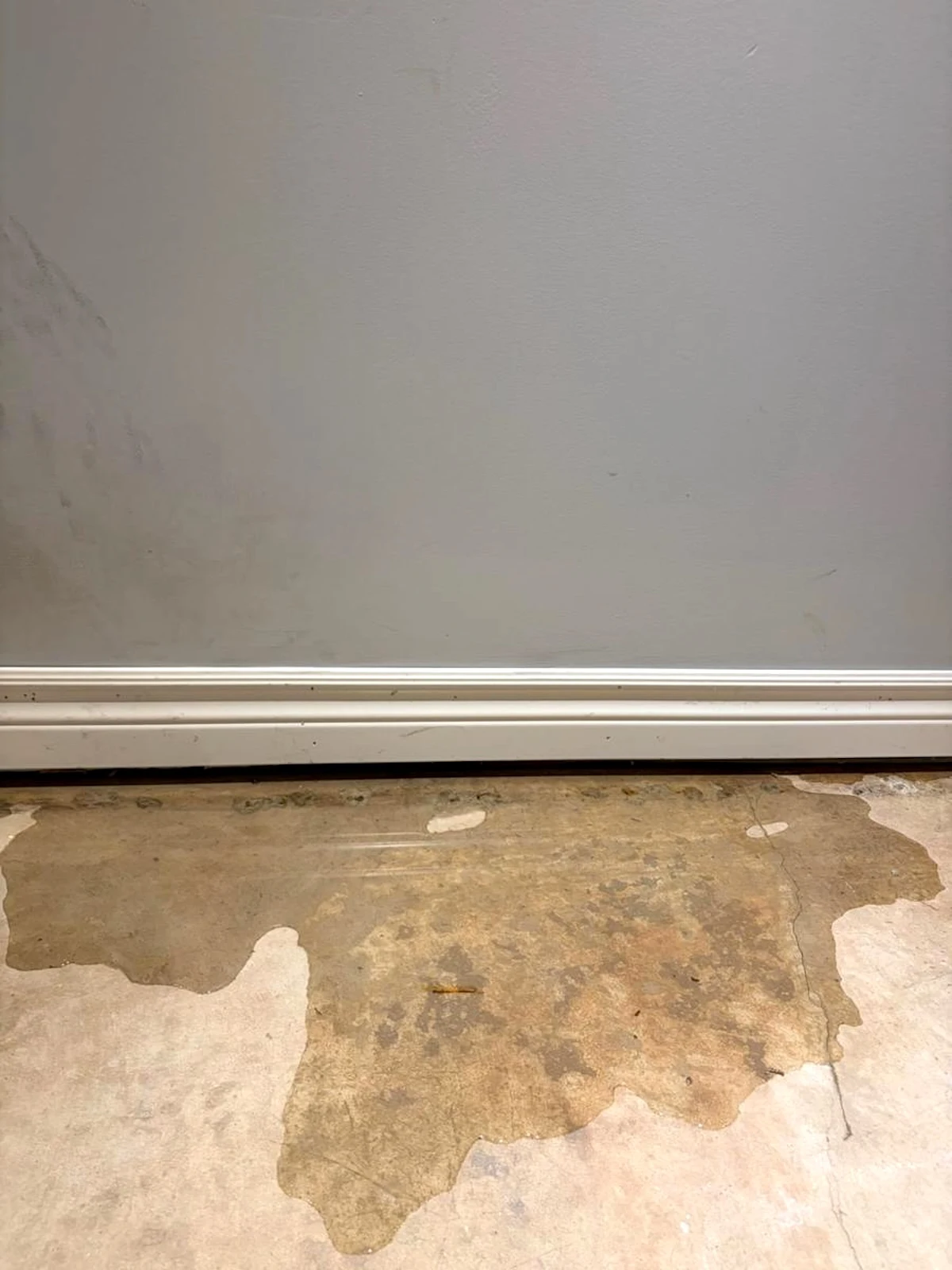
Possible Sources Behind the Wall
Concealed water may be entering through a foundation crack, a tie-rod hole, a leaking snap rod, honeycombing, a cold joint, a utility penetration or over the top of the foundation wall. In some basements, excessive moisture behind the insulation may also be caused by condensation rather than a leak.
How AquaGuard Injection Investigates the Leak
To properly inspect the foundation wall, the vapour barrier is usually slit vertically so the insulation can be opened and the concrete examined. The investigation begins directly above and around the area where water was first observed.
In most cases, water ingress leaves visible evidence. AquaGuard Injection looks for dark concrete staining, efflorescence, mineral staining, mud staining and other signs of moisture on the foundation wall.
If water has entered over the top of the foundation wall, staining may also be visible on the sill plate, floor joists or other wood framing above the concrete wall.
Don’t Guess What’s Behind a Finished Wall
When a basement is finished, many homeowners are understandably reluctant to open a wall to investigate the source of a leak. Unfortunately, without confirming where the water is actually entering, it is easy to misdiagnose the problem and spend thousands of dollars on a repair that doesn’t address the true source of the leak.
For example, a building envelope leak entering above the foundation wall may be mistaken for a foundation waterproofing problem. The foundation can then be excavated and waterproofed, yet the basement continues to leak because the original source of the water was never identified.
Understanding the Problem Comes First
AquaGuard Injection believes homeowners should understand the true source of a basement leak before deciding on a repair. Understanding and proving what is actually happening is the key to determining the best repair and course of action. Taking the time to identify the true source of the leak helps homeowners make informed decisions and reduces the risk of unnecessary repairs. If the source of the leak cannot be confirmed, see I Don’t Know Where the Water Is Coming From.
My Drywall, Flooring or Baseboards Are Wet, Stained or Moldy
Wet drywall, stained baseboards, buckled flooring and mold are all symptoms of a moisture problem. The visible damage tells you that water has been present, but it does not always explain why it is there.
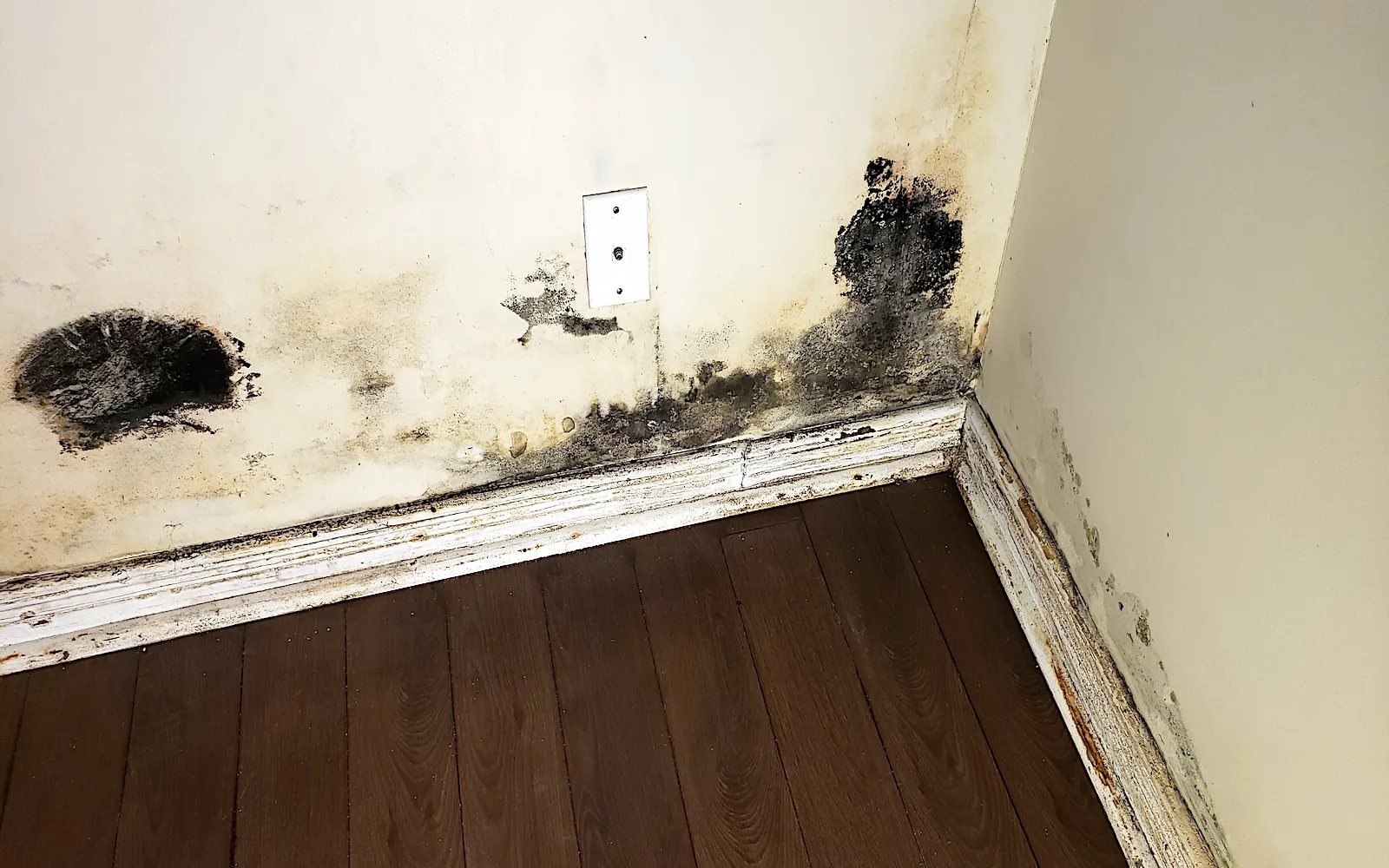
Common Signs of Moisture Damage
- Wet or stained drywall.
- Swollen or discoloured baseboards.
- Buckled laminate, hardwood or vinyl flooring.
- Wet carpet or underpad.
- Mold or mildew growth.
- A persistent musty odour.
What Is Causing the Damage?
Moisture damage can have many causes. Water may be entering through the foundation behind a finished wall, another part of the building envelope, or from a plumbing leak. Determining the true source of the moisture is the most important part of the investigation.
In most cases, the visible damage provides an excellent starting point for the inspection because the source of the problem is often found nearby. Understanding and proving what is actually happening is the key to determining the best repair and course of action.
How AquaGuard Injection Investigates These Problems
AquaGuard Injection begins by carefully inspecting the area where the damage is visible. When necessary, finished materials or insulation are opened so the foundation wall can be examined for staining and other evidence of water ingress.
Why an Accurate Diagnosis Matters
Determining the true source of a basement leak often takes time. It may require opening a finished wall, exposing the foundation or carrying out additional investigation before the cause can be confirmed. While it may be tempting to recommend a repair based only on the visible symptoms, doing so creates the risk of repairing the wrong problem.
AquaGuard Injection believes that repairs should be based on evidence, not assumptions. If the source of the leak cannot be positively identified, we will say so. In some situations, we recommend additional investigation by a leak detection specialist using moisture meters, infrared cameras and other specialized equipment before a repair decision is made. See I Don’t Know Where the Water Is Coming From.
Spending additional time to accurately identify the source of a leak can prevent homeowners from spending thousands of dollars on repairs that fail to address the real problem.
Repair the Cause Before the Damage
Before replacing drywall, flooring or baseboards, the source of the moisture should be identified, repaired and, where appropriate, confirmed through testing. Otherwise, the damage is likely to return the next time the same conditions occur. See There Is Water on My Basement Floor if you’re unsure where to begin.
Once the source of the moisture has been identified and corrected, damaged finishes can be repaired with confidence.
There Is a Crack in My Foundation Wall
Finding a crack in your foundation wall can be alarming, but most foundation cracks do not mean your home is structurally unsafe. Many develop naturally as concrete cures and shrinks or as the foundation undergoes minor settlement. Some cracks remain dry for years, while others begin leaking during heavy rain or the spring thaw.
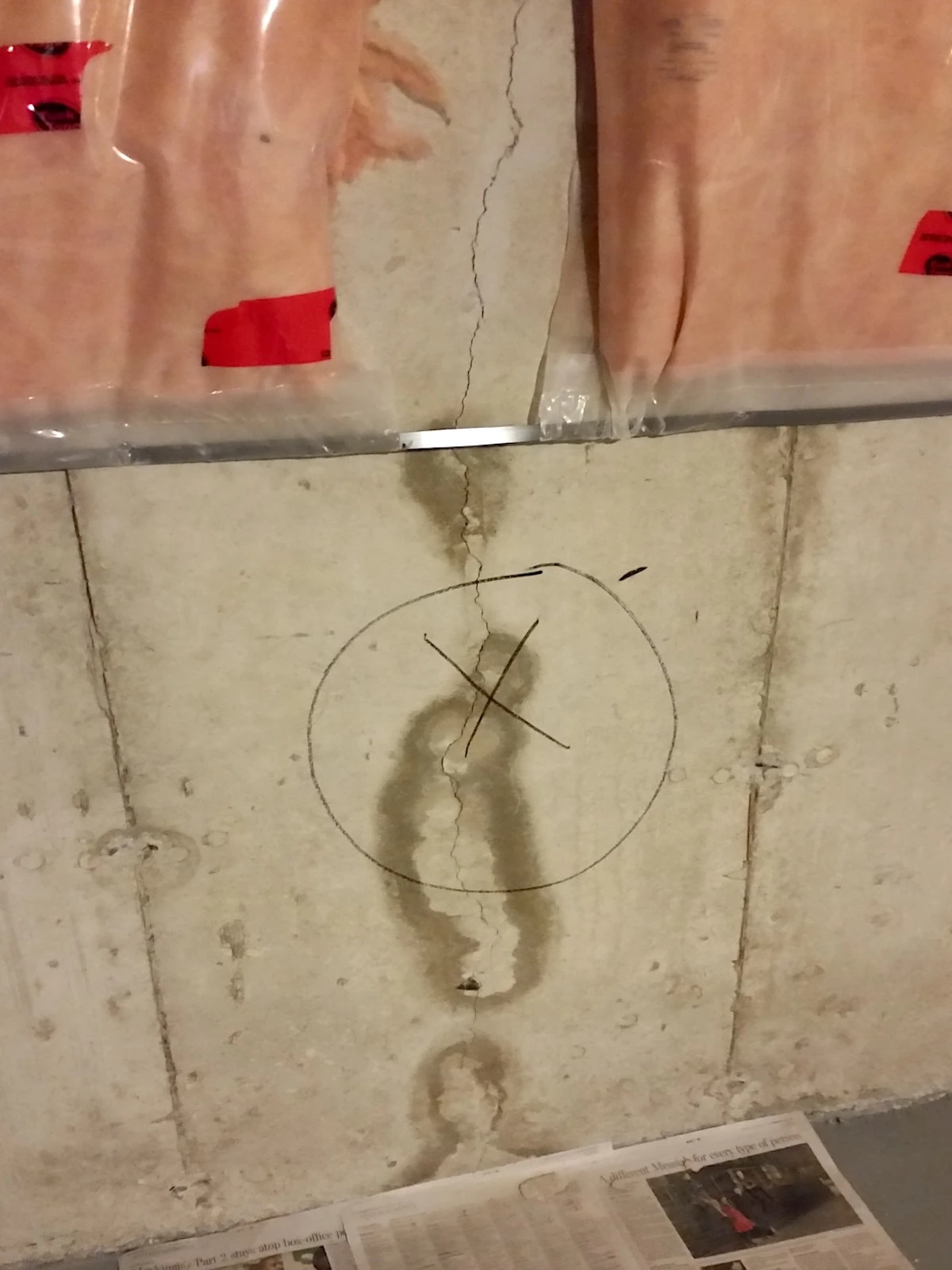
The first step is determining whether the crack is actively leaking, has leaked in the past, or has the potential to allow water into your basement in the future.
Signs the Crack May Be Leaking
- Water dripping or running from the crack.
- Damp concrete surrounding the crack.
- White mineral deposits (efflorescence).
- Brown or rust-coloured staining.
- Mold or mildew nearby.
- Wet flooring, carpet or finishes below the crack.
What Should You Do?
Not every foundation crack requires immediate repair, but evidence of water intrusion should never be ignored. Repairing a leaking crack early can help prevent damage to drywall, insulation, flooring and other finished materials, while also reducing the risk of mold growth.
How AquaGuard Injection Repairs Leaking Foundation Cracks
Most leaking poured concrete foundation cracks can be permanently repaired from the inside using polyurethane crack injection. In most cases, this eliminates the need for excavation while creating a flexible waterproof seal designed to move with normal foundation movement. AquaGuard Injection backs these repairs with a 25-year transferable written warranty.
Learn more: Complete Foundation Crack Repair Guide
There Is a Leaking Hole in My Foundation Wall
Not every basement leak comes through a foundation crack. Poured concrete foundations can also leak through tie-rod holes, snap rods and utility penetrations. Although these leaks may look similar to the homeowner, they are created in different ways and require different explanations before they can be properly repaired.
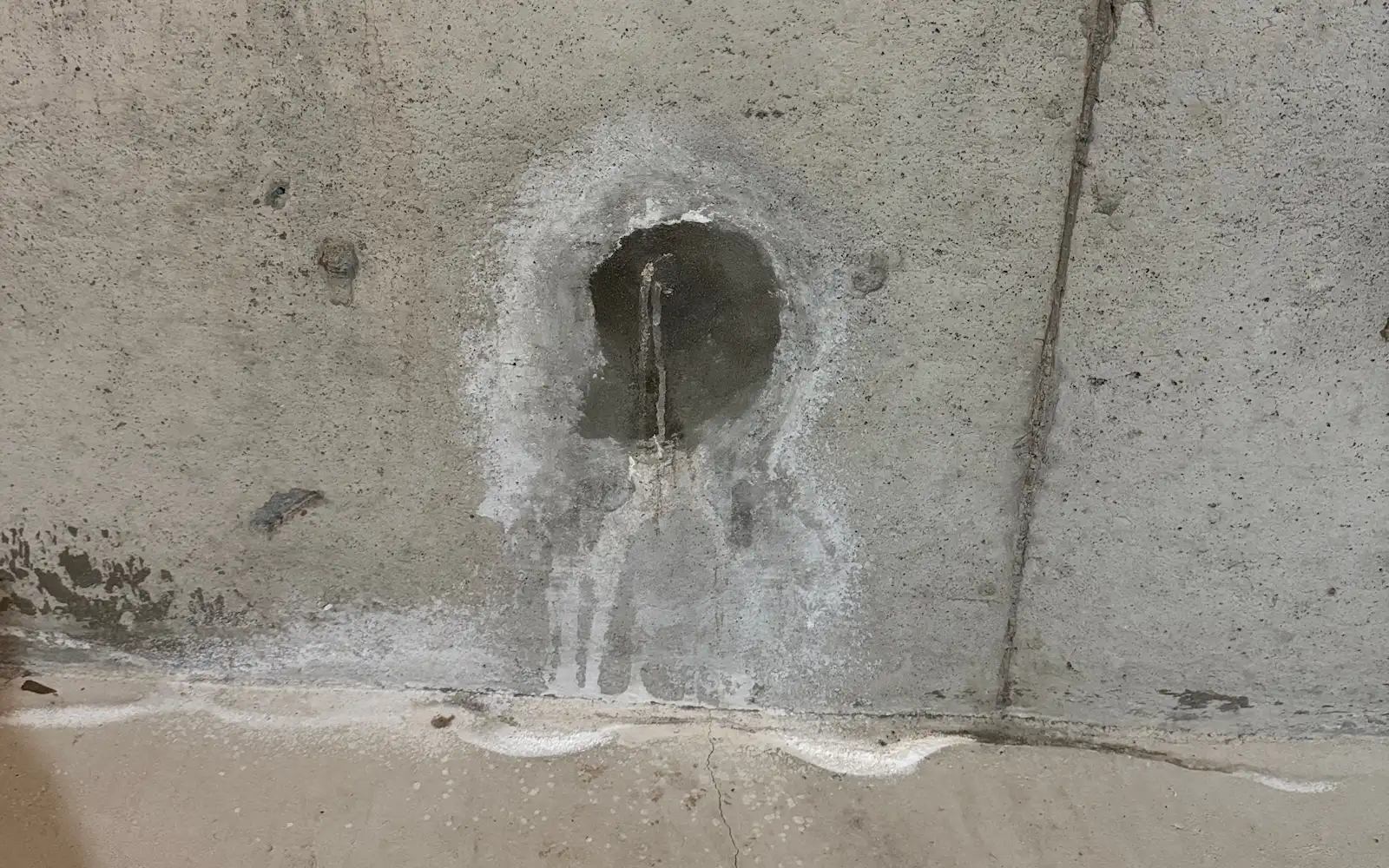
Leaking Tie-Rod Holes
Tie-rod holes are actual circular holes, typically about 5/8 inch (16 mm) in diameter, left behind after removable tie rods are extracted from the concrete forms following construction. These holes are normally sealed during construction, but over time the seal can fail, allowing groundwater to enter the basement.
Leaking Snap Rods
Some poured concrete foundations were built using snap rods instead of removable tie rods. Unlike a tie-rod hole, a snap rod remains embedded in the concrete after the forms are removed, with the ends snapped off flush with the wall surface. These occasionally leak because air entrapment along the rod creates a pathway that allows groundwater to travel through the wall.
Utility Penetrations
Water can also enter through holes drilled through the foundation wall for electrical conduit, plumbing, gas lines, cable or other utilities. If these penetrations are not properly sealed, they can become a source of basement leaks.
How AquaGuard Injection Repairs These Leaks
AquaGuard Injection repairs leaking tie-rod holes, leaking snap rods and leaking utility penetrations using repair methods specifically suited to each type of leak. In most cases, repairs are completed from inside the basement without excavation and are backed by AquaGuard Injection’s 25-year transferable written warranty.
Learn more:
Tie-Rod Hole Leak Repair
Water Is Leaking Around My Basement Window
Significant basement window leaks are usually caused by a problem with the window well, not the window itself. When a large amount of water enters the basement through a basement window, it usually means the water found an easy path into the home.
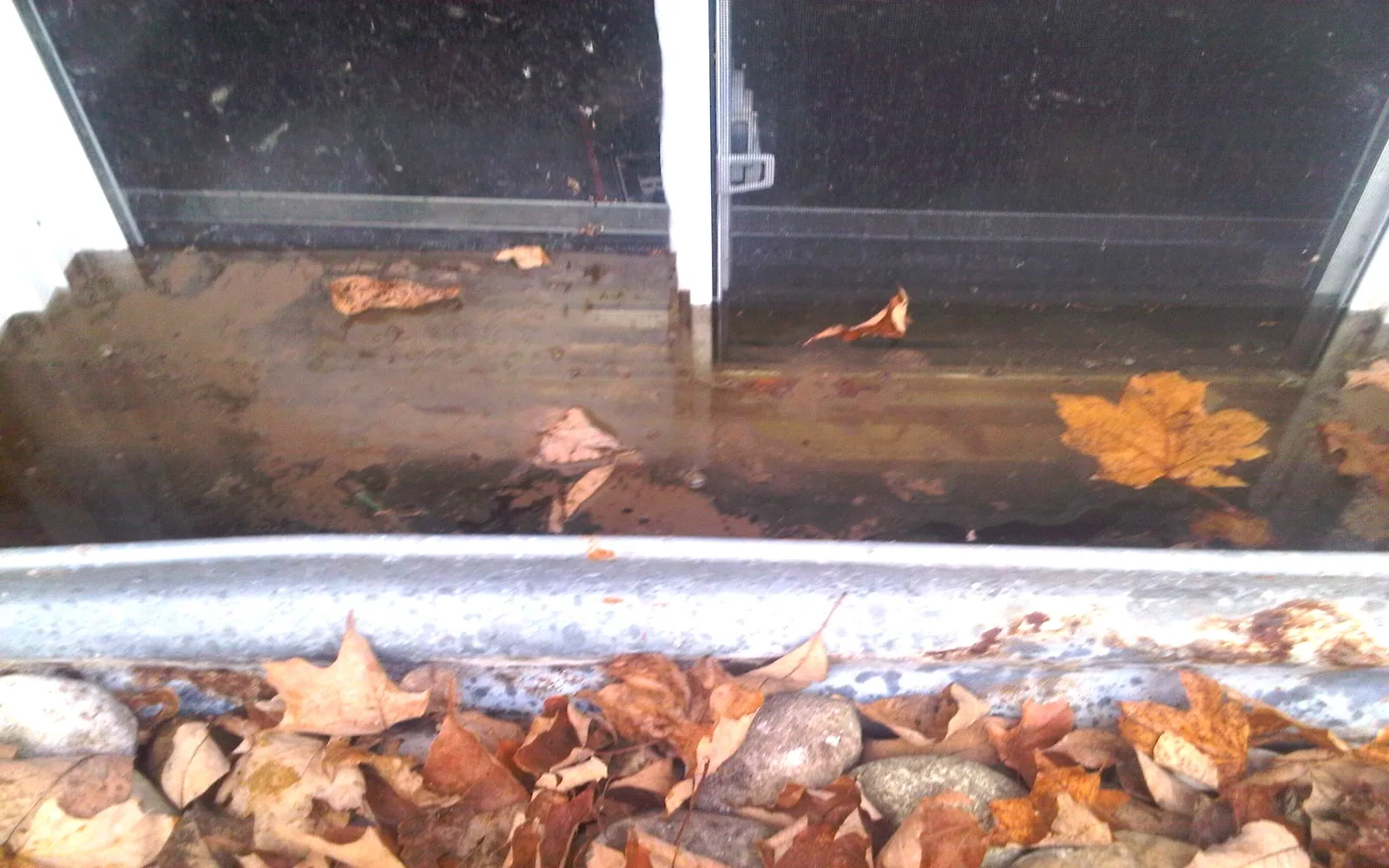
Common Causes of Basement Window Leaks
The most common cause is a window well that is too short, allowing surface water to flow underneath it and fill the window well. Window wells can also fill with water if they are not securely attached to the foundation wall, allowing water to enter behind the well. Once the water level rises above the bottom of the basement window, it can enter the home.
Another common problem occurs when an eavestrough or downspout discharges roof water directly into the window well. During heavy rain, the well can quickly fill with water and overflow into the basement. Redirecting roof water away from the window well and, where appropriate, installing a custom window well cover can often prevent this problem.
Some window wells include drains, while many do not. A drain is often unnecessary if the window well is properly sized, correctly installed and protected from excessive surface water. The objective is to prevent large volumes of water from collecting in the window well.
How AquaGuard Injection Solves Basement Window Leaks
AquaGuard Injection first determines why the window well is filling with water. In many cases, the permanent solution is to replace the existing window well with a properly installed, deeper window well that extends well below the basement window. This prevents surface water from entering the window well and greatly reduces the likelihood of future leaks.
Depending on the cause of the leak, additional repairs may include redirecting roof water away from the window well, improving drainage, installing a custom window well cover, or waterproofing the surrounding foundation where necessary.
Water Is Leaking Over the Top of My Foundation Wall
If water is entering over the top of your foundation wall, the problem is usually not a basement waterproofing issue. In most cases, it is a building envelope leak. Water enters the exterior of the home somewhere above the foundation, travels down inside the wall, and eventually appears at the top of the foundation wall before running into the basement, often emerging from behind insulation or a finished wall.
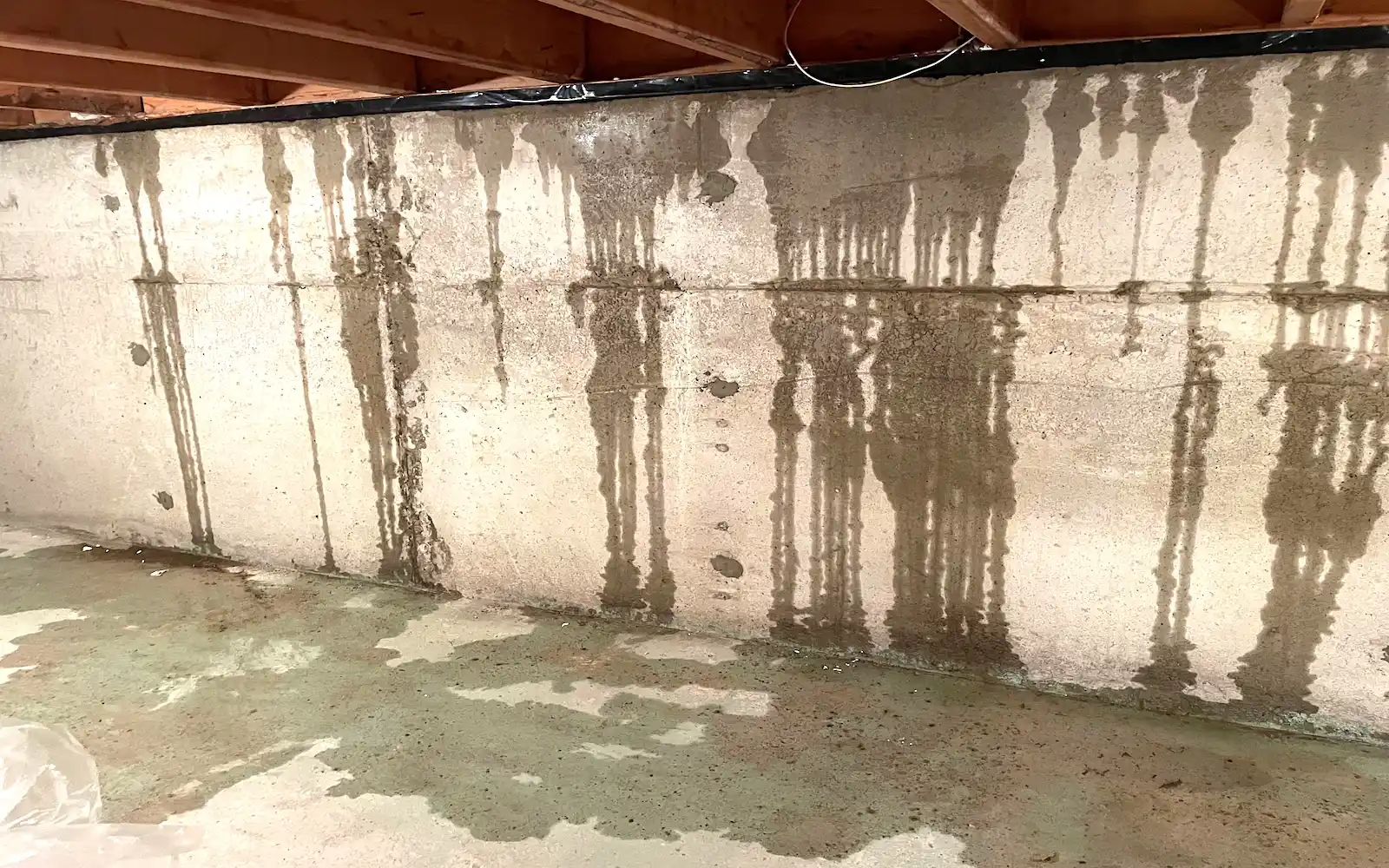
Common Sources of Building Envelope Leaks
Building envelope leaks can originate anywhere from the top of the foundation wall to the roof. One of the most common causes is poor landscaping. Patio steps, walkways or sloping ground can allow water to collect against the house, where it enters at the sill plate—the point where the wood framing begins on top of the foundation.
Water may also enter through damaged brick mortar joints, deteriorated caulking around patio doors, doors or windows, leaking window sills on the first or second floor, roof or flashing defects, leaking exterior hose bibs inside the wall, or through the electrical junction box behind an exterior light fixture. Once inside the wall, the water travels downward until it reaches the top of the foundation wall, making it appear that the foundation itself is leaking.
How AquaGuard Injection Diagnoses These Leaks
The first step is confirming that the water is actually entering over the top of the foundation wall. This is often done by exposing the top of the foundation wall, such as by pulling back the vapour barrier in an unfinished basement, and observing where the water is entering. This approach is discussed in more detail in Water Is Coming From Behind the Insulation or Finished Wall.
Once the entry point has been confirmed inside, the exterior of the home is carefully inspected directly above that location. In some situations, controlled water testing is performed to help identify the exact point where water is penetrating the building envelope.
When the Source Isn’t Obvious
Building envelope leaks can sometimes be difficult to trace because water may travel a considerable distance inside the wall before becoming visible in the basement. If the source of the leak cannot be identified during a visual inspection, it may be worthwhile to hire a building leak inspection company. These specialists use moisture meters, infrared cameras and other diagnostic equipment to help locate the true point of water ingress. See also I Don’t Know Where the Water Is Coming From.
The Right Repair Depends on the Cause
Because these are building envelope leaks, the appropriate repair depends on where the water is entering the home. The solution may involve improving grading, repairing masonry, replacing deteriorated caulking around doors or windows, correcting roof or flashing problems, repairing a leaking hose bib, sealing around an exterior light fixture, or another building envelope repair. Basement waterproofing is usually not the solution. Understanding and proving what is actually happening is the key to determining the best repair and course of action.
Water Seems to Be Coming Up Through My Basement Floor
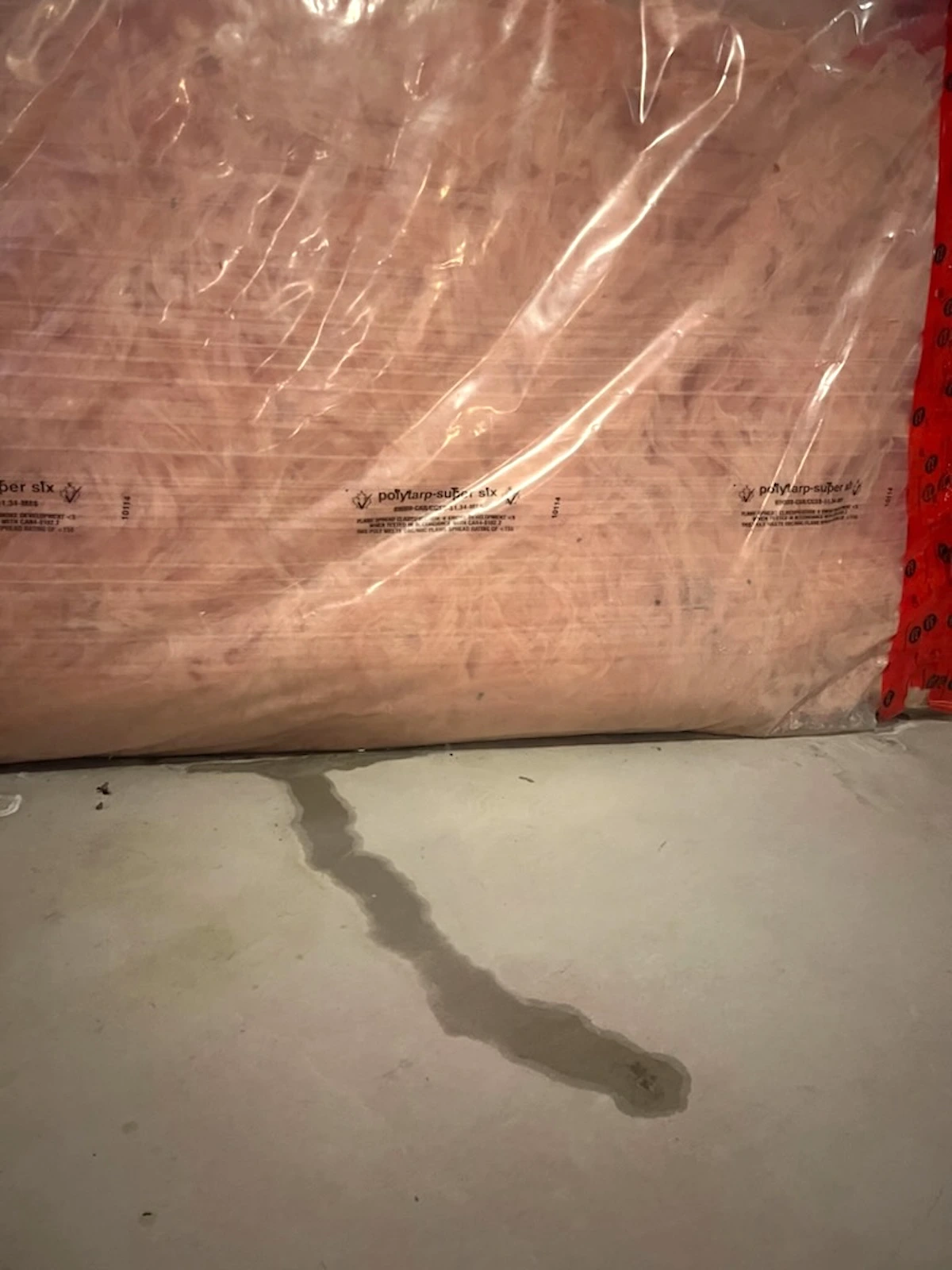
Homeowners often believe that water is coming up through the basement floor, but that is not always the case. Water entering anywhere from the roof to the foundation can eventually make its way to the basement floor, making it appear that the floor is the source of the leak.
Don’t Jump to Conclusions
Water found on the basement floor does not prove that it originated beneath the concrete. It may have entered through a foundation crack, a leaking tie-rod hole, behind insulation, over the top of the foundation wall or another concealed location before finally becoming visible on the floor.
Understanding and proving what is actually happening is the key to determining the best repair and course of action.
When the Water Really Is Coming From Beneath the Floor
In some situations, water is actually entering from beneath the basement floor. Determining why this is happening can be considerably more complicated than diagnosing a typical foundation wall leak and often requires additional investigation beyond a standard basement waterproofing inspection. See also I Think My Weeping Tiles Have Failed.
Depending on the circumstances, further investigation may involve a drain-laying contractor or plumbing contractor using specialized equipment, such as drain cameras, to evaluate the underground drainage system.
Our Recommendation
AquaGuard Injection believes that successful repairs begin with an accurate diagnosis. If the source of the water cannot be confidently determined, it is better to continue the investigation than to guess at the solution. See I Don’t Know Where the Water Is Coming From.
My Basement Leaks After Heavy Rain or During the Spring Thaw
Heavy rain and melting snow can place significant hydrostatic pressure on a foundation. A crack or other opening that remains dry during light rain may begin leaking when the surrounding soil becomes saturated and water pressure increases.
Prolonged rain can also expose weaknesses elsewhere in the building envelope, including around windows, doors, exterior light fixtures and electrical boxes. For that reason, the timing of a leak provides useful clues, but does not prove where the water is entering.
Questions That Help Narrow the Cause
- Is this a new problem or an existing one?
- Does the basement leak every time it rains or only during heavy storms?
- Does the leak occur every spring during snowmelt?
- Did the problem begin after landscaping, grading or renovation work?
- Has a neighbouring property recently changed its grading or drainage?
- Could the timing of the leak be coincidental rather than weather-related?
Weather Provides Clues, Not Proof
Homeowners often connect a leak with a recent storm, but the true cause still needs to be confirmed. In some cases, a plumbing leak or another unrelated problem is discovered at the same time as heavy rain. If water is appearing from behind insulation or a finished wall, further investigation may be required.
The history and frequency of the leak are important, but they should be considered together with physical evidence found during the inspection.
Targeted Repair or Broad Waterproofing?
There is more than one way to address a basement leak. One approach is to waterproof an entire wall or foundation. This can provide broad protection, but it is also more extensive, more disruptive and typically more expensive.
Another approach is to first determine exactly how and where the water is entering. If the source can be positively identified, a targeted repair may resolve the problem with far less disruption and at a much lower cost.
The right approach depends on the circumstances and the homeowner’s goals. Whenever practical, AquaGuard Injection believes homeowners should understand the true source of a basement leak before deciding on a repair.
Understanding the Problem Comes First
AquaGuard Injection uses the timing of the leak, the homeowner’s observations and the physical evidence found during the inspection to determine the most likely cause. Only after the source has been identified and confirmed can the best repair and course of action be recommended. If the source cannot be confirmed, see I Don’t Know Where the Water Is Coming From.
I Think My Weeping Tiles Have Failed
Many homeowners assume that any basement leak means the weeping tile has failed. In reality, a blocked or damaged weeping tile system can be difficult to diagnose, and many basement leaks are caused by problems that occur well above the footing, such as a foundation crack, leaking tie-rod hole or building envelope leak.
Signs That May Suggest a Drainage Problem
In an unfinished basement, broad efflorescence or moisture staining near the bottom of the wall may suggest that water is accumulating outside the foundation or beneath the basement floor. However, these signs do not prove that the weeping tile is blocked.
By contrast, a leak entering through a crack or opening several feet above the basement floor is unlikely to have been caused by blocked weeping tile. The water is entering the basement before it ever reaches the drainage system at the footing.
Why Weeping Tile Problems Are Difficult to Confirm
The condition of an exterior weeping tile system usually cannot be confirmed through a visual basement inspection alone. In many cases, direct access, excavation or specialized drainage investigation is required to determine whether the system is blocked, damaged, disconnected or functioning properly.
The weeping tile forms a continuous drainage system around the foundation. Replacing one section may not solve the problem if the new section is connected to older sections that remain blocked, damaged or disconnected.
Flushing Is Not a Guaranteed Solution
Weeping tile flushing may help in some situations, but it does not resolve every basement leak and cannot always restore a damaged drainage system. Clay tile may be disconnected or collapsed, and high-pressure equipment may be unable to pass through tight bends or damaged sections.
If a blockage is discovered during excavation, flushing may require additional contractors, delays and increased costs, and successful cleaning still cannot always be guaranteed.
Downspouts Should Not Discharge Into the Weeping Tile
Many older homes were built with downspouts connected directly into the exterior weeping tile system. While this keeps roof water out of sight, it is generally not recommended.
Roof water carries leaves, shingle grit and other debris from the eavestrough system. Over time, this material can accumulate inside the weeping tile, restricting drainage or contributing to blockages.
The volume of water coming from a roof during heavy rain can also overwhelm the drainage system. Instead of carrying groundwater away from the foundation, the weeping tile may become overloaded, allowing water to accumulate around or beneath the basement floor. In some cases, this can contribute to seepage at the cove joint.
For these reasons, modern building practices generally keep roof drainage and foundation drainage separate. Although some older homes still have these connections, they are no longer recommended and, in some municipalities, are no longer permitted for new construction.
Our Recommendation
AquaGuard Injection does not assume that a basement leak is caused by failed weeping tile. We first look for foundation cracks, leaking tie-rod holes and other identifiable sources that can be confirmed and repaired directly.
When a drainage system problem is suspected but cannot be proven, further investigation by an experienced drain-laying or plumbing contractor may be appropriate before committing to extensive excavation or foundation waterproofing. If the source of the leak remains uncertain, see I Don’t Know Where the Water Is Coming From.
As with every basement leak, understanding and proving what is actually happening is the key to determining the best repair and course of action.
My Foundation Wall Has White Powder, Dark Staining or Mud Staining
White powder, dark staining and mud staining are all signs that moisture has been present on your foundation wall. Although these conditions do not always indicate an active leak, they often provide valuable clues about previous moisture ingress and can help identify where water has entered the basement.
White Powder (Efflorescence)
Efflorescence is the white powdery residue that sometimes appears on foundation walls. It forms when water passes through the concrete, dissolves naturally occurring mineral salts and leaves them behind as the water evaporates. Efflorescence is one of the most common signs of previous moisture ingress.
Dark Staining
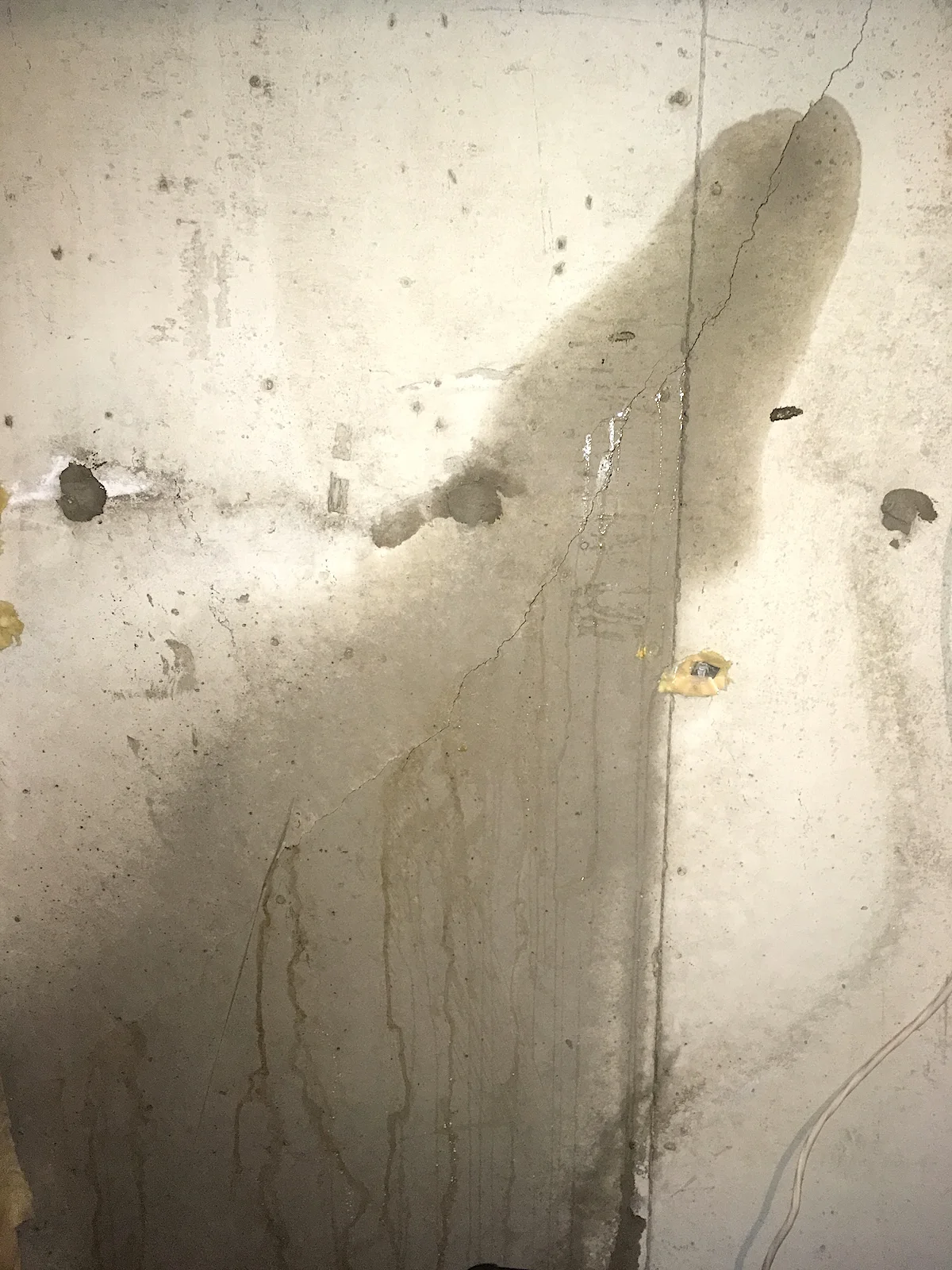
Dark staining often indicates that the concrete has become saturated with moisture. The wall may appear darker than the surrounding concrete or show irregular damp-looking patches. Even if the wall is dry when inspected, dark staining suggests that water has repeatedly entered the foundation in the past and the source should be investigated. Water may be entering through a foundation crack, leaking hole or another opening in the foundation wall.
Mineral Staining
Mineral staining is less common than efflorescence but is also evidence of previous moisture ingress. The staining may vary in colour and appearance depending on the minerals carried through the concrete by the water.
Mud Staining
Mud staining is a strong indication that groundwater has entered through a crack, tie-rod hole or another opening in the foundation wall. As the water drains into the basement, it carries fine soil particles that remain on the wall after the water evaporates.
Rust Staining Behind Insulation
Rust staining is commonly found on the metal retaining strip at the bottom of insulation blankets rather than on exposed concrete. This usually indicates prolonged moisture behind the insulation. The moisture may be caused by condensation, a building envelope leak or a concealed foundation leak.
What Should You Do?
These signs should not be ignored. They may indicate an intermittent leak that occurs only during heavy rain or the spring thaw. Identifying the source of the moisture early can help prevent more extensive damage and reduce the likelihood of mold developing in finished areas of the basement.
Frequently Asked Questions About Basement Leaks
What causes a basement leak?
Basement leaks can result from foundation cracks, leaking tie-rod holes, basement window problems, building envelope leaks, concealed leaks behind insulation, drainage problems or water entering from beneath the floor.
How do I find the source of a basement leak?
Begin where the water is first observed and look nearby for staining, damp concrete, cracks, leaking holes, wet insulation or water around a basement window. The source should be identified and confirmed before choosing a repair.
Does water on my basement floor mean it came through the floor?
No. Water may have entered through a wall, window, concealed opening or over the top of the foundation before collecting on the floor. Water should not be assumed to be coming from beneath the floor without evidence.
How can I tell if a foundation crack is leaking?
Signs include active water, damp concrete, efflorescence, staining, mold or wet flooring beneath the crack. Some cracks leak only during heavy rain or the spring thaw.
Why does my basement leak only during heavy rain or spring thaw?
Saturated soil can increase water pressure against the foundation, causing cracks or openings that remain dry during lighter rain to leak. Prolonged rain can also expose problems elsewhere in the building envelope.
Does a basement leak mean the weeping tile has failed?
Not necessarily. Many leaks occur well above the footing and are unrelated to the weeping tile. A blocked or damaged weeping tile system can be difficult to confirm without further investigation.
What does white powder or staining on a foundation wall mean?
White powder, dark staining, mineral deposits and mud staining can indicate previous moisture ingress. These signs may help identify where water has entered, even when the wall is dry during the inspection.
What should I do if I cannot determine where the water is coming from?
Avoid committing to a major repair based on assumptions. Continue the investigation and, when necessary, consult a qualified leak detection, drainage or plumbing specialist before deciding on a solution.
I Don’t Know Where the Water Is Coming From
If you don’t know where the water is coming from, you’re not alone. Many basement leaks are intermittent, concealed behind finished walls or insulation, or only occur under certain weather conditions. Determining the true source of a leak often requires careful observation and a systematic inspection.
Start With the Evidence
The investigation should begin where the water is first observed. Look for staining, damp concrete, wet insulation, foundation cracks, leaking holes, moisture around basement windows or signs that water has entered over the top of the foundation wall.
The history of the leak is also important. Does it occur only during heavy rain, every spring during snowmelt, or throughout the year? Is it a new problem or one that has existed for years? These observations often provide valuable clues, but they do not prove the source of the leak.
Don’t Rush Into Repairs
Basement leaks are not always caused by the first problem that comes to mind. A foundation leak, building envelope leak, basement window leak, plumbing leak or another concealed source can produce similar symptoms. Repairing the wrong problem can result in unnecessary expense while the leak continues.
AquaGuard Injection’s Approach
AquaGuard Injection believes homeowners should understand the true source of a basement leak before deciding on a repair. Whenever practical, we first identify and confirm the source of the water before recommending a solution.
In some situations, the source of a leak cannot be positively identified during a basement waterproofing inspection. When that happens, we will say so. Additional investigation by a leak detection specialist or another qualified contractor may be the most appropriate next step before any major repair is undertaken.
Our Philosophy
Understanding and proving what is actually happening is the key to determining the best repair and course of action. A careful diagnosis helps homeowners make informed decisions, avoid unnecessary repairs and choose the solution that best addresses the actual problem.