

Foundation Crack Repair: Complete Homeowner Guide
Learn what causes foundation cracks, why they leak, how they are repaired, and how to choose the right repair method for your home.
Topics covered: foundation crack causes, crack leakage, polyurethane crack injection, epoxy vs polyurethane, repair options, repair costs, and frequently asked questions.
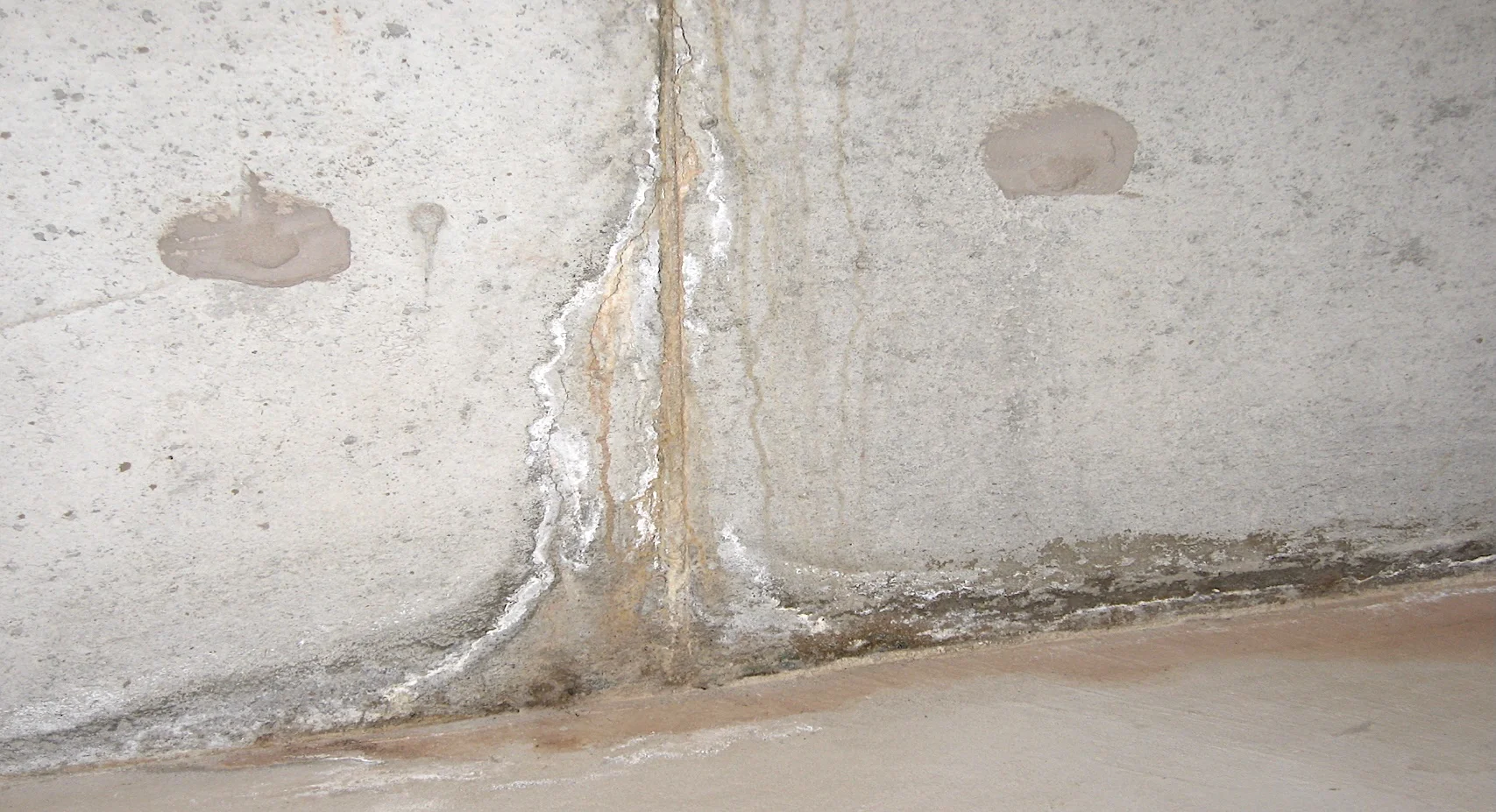
Table of Contents
- Introduction
- What Is a Foundation Crack?
- Why Foundation Cracks Occur
- Why Foundation Cracks Leak
- Types of Foundation Cracks
- Crack Leakage
- Signs a Foundation Crack Needs Repair
- Foundation Crack Repair Options
- Choosing the Right Repair
- Crack Injection Explained
- Polyurethane Crack Injection Explained
- Comparison of Epoxy & Polyurethane Injection
- Foundation Crack Repair Costs
- Frequently Asked Questions
- Conclusion
Introduction
Discovering a crack in a foundation wall can be alarming for a homeowner. Some cracks remain dry and stable for years, while others allow water into the basement, worsen over time, or indicate a more significant structural concern.
Unfortunately, the foundation crack repair process is often surrounded by confusion. Homeowners are told they need excavation when they do not and others are sold cosmetic repairs that ultimately do not stop water infiltration. Consequently, some cracks are ignored until basement leaks develop and damage finished basement walls, flooring, or stored belongings.
The purpose of this guide is to explain foundation cracks, why they occur, how they are evaluated, and the repair options available. Whether you have discovered a hairline crack, water seepage after a heavy rain, or an actively leaking basement wall crack, understanding the problem is a crucial first step toward selecting the right repair.
In this guide, you’ll learn:
- Why foundation cracks develop;
- Which cracks are most likely to leak;
- How foundation cracks are repaired;
- The differences between epoxy and polyurethane injection;
- What foundation crack repairs typically cost; and
- How to make informed repair decisions.
Many homeowners are surprised to learn that most leaking cracks in poured concrete foundation walls can be repaired from inside the basement using professional crack injection methods that do not require excavation.
Before discussing repair options, it is important to understand what a foundation crack is and why foundation walls crack in the first place.
Have a Foundation Crack?
Most leaking poured concrete foundation cracks can be repaired from inside the basement without excavation.
What Is a Foundation Crack?
A foundation crack is a separation that develops within a concrete foundation wall, think of it like a long narrow void in the foundation. Cracks can appear shortly after construction of your home, or many years later as the foundation responds to changing conditions.
Residential foundation cracks occur in both poured concrete and block basement walls. Concrete is extremely strong when compressed but is weaker when stretched or pulled apart. When stresses develop within the wall, the concrete often relieves those stresses by cracking.
Foundation cracks can appear in many forms, as follows:
- Vertical cracks;
- Diagonal cracks;
- Horizontal cracks; and
- Multiple interconnected cracks.
The existence of a foundation crack does not mean that you have a structural problem with your home. In fact, most foundation cracks are the result of normal concrete behaviour and environmental conditions acting on the structure over time.
However, every crack represents a potential pathway for groundwater. Even a fine hairline crack can allow groundwater to enter your basement when there is sufficient water pressure underground against the wall.
Foundation cracks are typically evaluated by their appearance. The location, width, and direction provide important clues about the cause of the crack and hence, the most appropriate repair method.
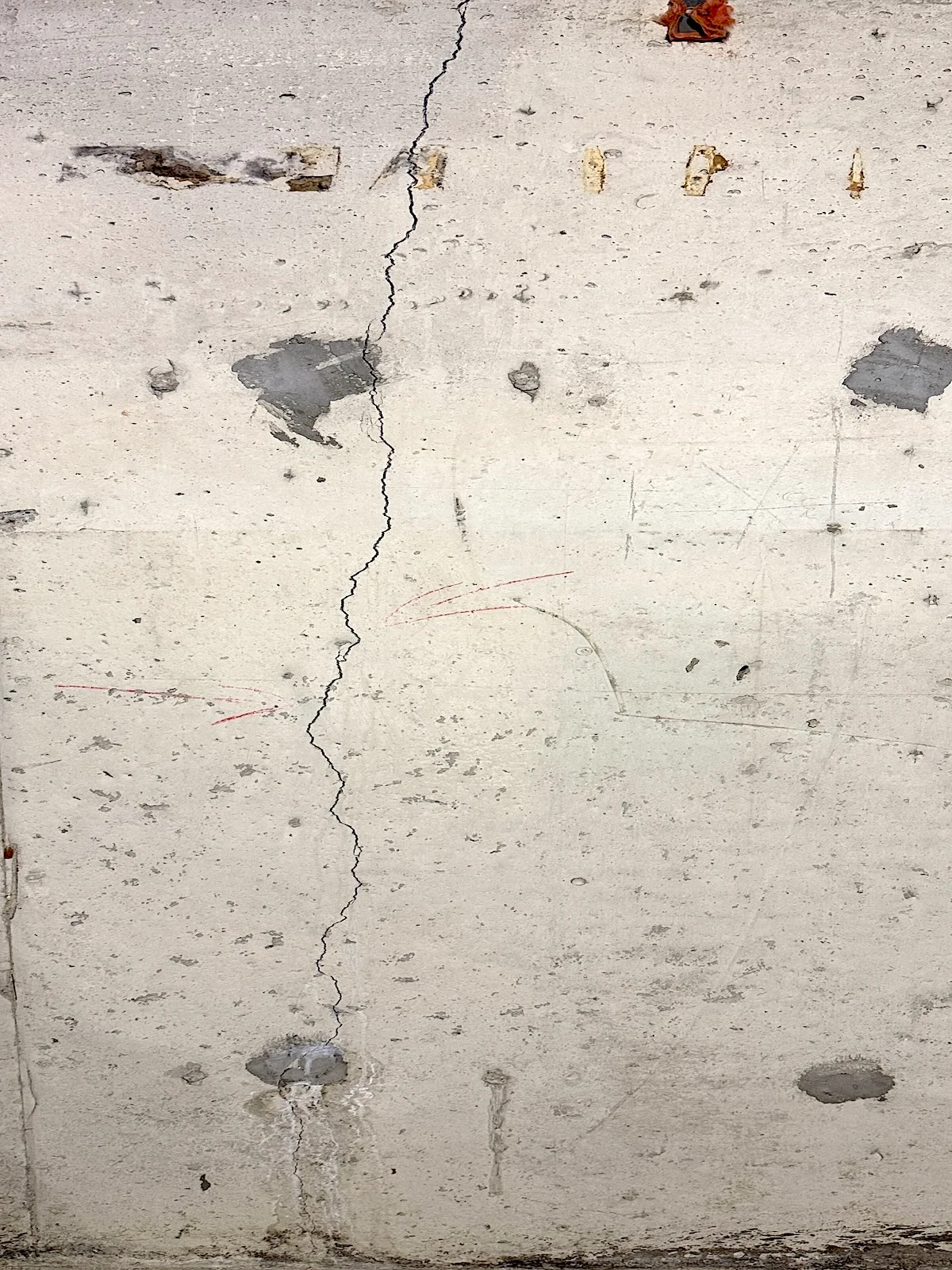
Why Foundation Cracks Occur
Foundation cracks develop for a variety of reasons. Some are the result of normal concrete curing after pouring, while others are caused by movement of the structure, environmental conditions, construction defects, or external forces acting on the foundation.
Concrete Shrinkage
Concrete shrinkage is the most common cause of foundation cracks in poured concrete walls.
Concrete is made from water, cement, sand, and aggregate (gravel). As the concrete cures and dries, moisture gradually leaves the concrete and the material shrinks. Hardened concrete typically shrinks approximately 1/16 inch (1.5mm) over a distance of 10 linear feet.
Over the length of a foundation wall, this shrinkage creates internal tensile stresses. Because concrete has limited tensile strength, the stress is often relieved through the formation of a crack.
Shrinkage cracks typically appear as vertical cracks that are fairly narrow and they may develop shortly after construction or become visible many years later.
Settlement
Settlement occurs when the soil supporting a home’s foundation does not adequately support the structure.
This can occur when:
- Soil beneath the footing compresses or sinks, especially when poor soil conditions exist beneath the footing, or soil erodes; and
- Soil moisture conditions change significantly, particularly during prolonged dry periods.
These conditions can reduce support beneath sections of the foundation and contribute to the development of new cracks as the foundation settles.
Settlement-related cracks are often diagonal. Wider cracks indicate that more significant movement has occurred and should be evaluated carefully.
Frost Movement
In climates such as that of Southern Ontario, frost movement can place significant stress on foundation walls.
When soil surrounding a foundation becomes saturated with water and subsequently freezes, the expansion associated with freezing can exert considerable pressure against the basement foundation wall. In extreme circumstances foundations are subjected to frost quakes.
The most recent cluster of notable frost quakes (cryoseisms) in the Greater Toronto Area (GTA) occurred during the winter of 2023. Dozens of residents, particularly in the Durham Region and surrounding areas, reported loud, booming sounds and localized ground shaking on Christmas Eve.
Improper Foundation Loading
Foundation walls are designed to support the weight of the structure above them. In some situations, concentrated loads can create localized stress within the concrete.
Examples include:
- Structural beam bearing locations; and
- Concentrated loads near window openings.
These localized stresses may contribute to crack development, particularly when combined with settlement or other forms of movement.
Construction Defects
The quality of the original construction of your foundation can influence whether foundation cracks develop and whether they later become sources of basement leaks.
Examples of construction-related issues include:
- Poor concrete consolidation – insufficient removal of trapped air pockets and voids from freshly poured concrete;
- Honeycombing – areas of visible aggregate;
- Weak concrete mixes – low cement content and/or excess water;
- Improper curing – when the concrete loses moisture too quickly or experiences extreme temperatures;
- Winter concrete placement – if the concrete freezes during its critical early stages, it can permanently lose up to 50% of its potential design strength; and
- Cold joints between pours – an unplanned weak seam or discontinuity that forms in concrete. It occurs when fresh, workable concrete is poured against a previous layer that has already begun to set or harden. Instead of fusing into one solid, homogeneous mass, the two layers fail to bond properly.
All of these issues can create weak areas that render the concrete more susceptible to cracking and subsequently water infiltration.
Vibration and Nearby Construction
Although less common, significant vibration can contribute to concrete cracking.
Potential sources include:
- Swimming pool construction;
- Blasting operations; and
- Repeated heavy equipment traffic near the foundation.
Vibration is not necessarily the sole cause of cracking, but it can aggravate existing weaknesses within the concrete and contribute to crack formation.
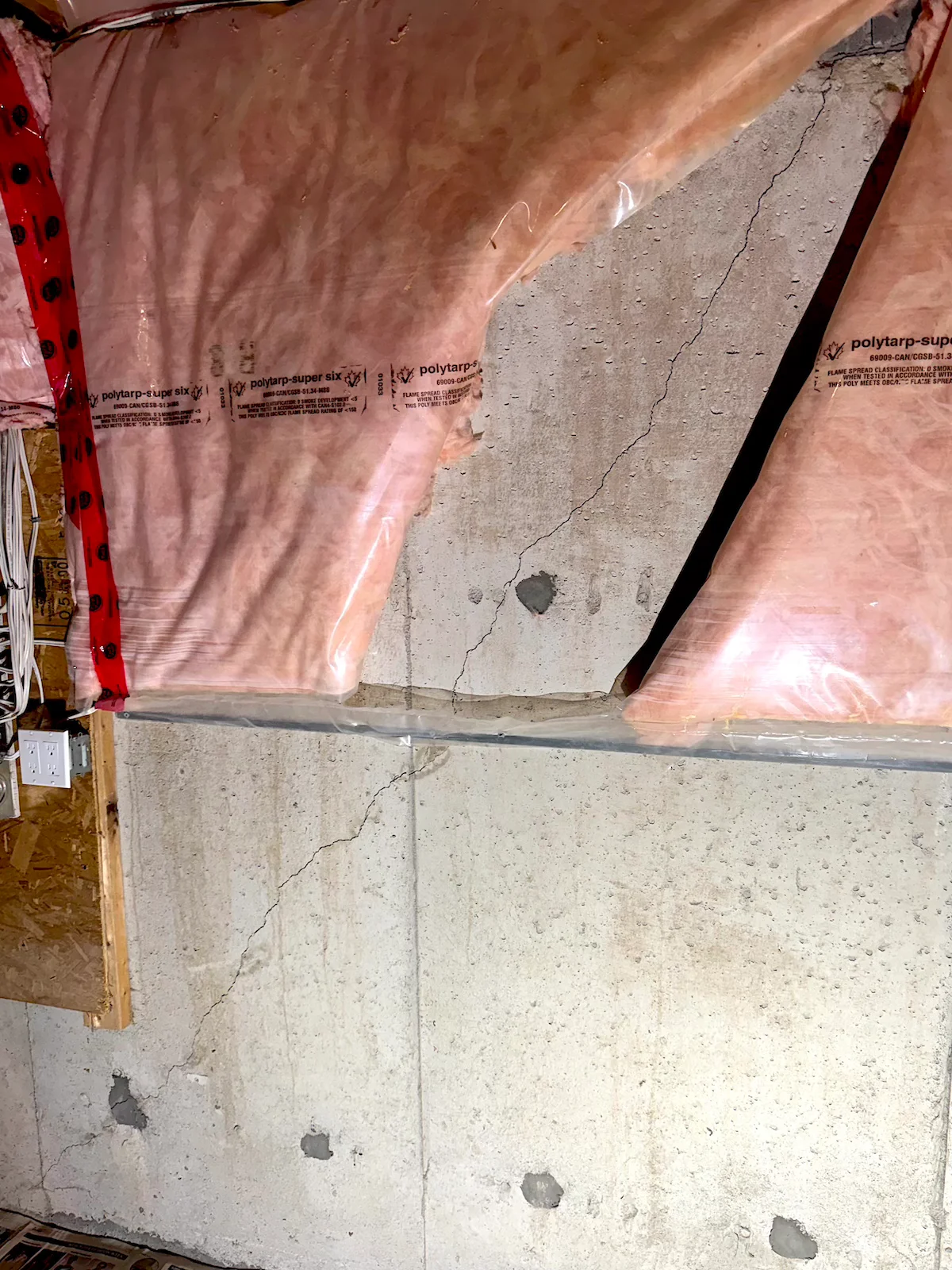
Diagonal foundation cracks are commonly associated with foundation settlement and movement.
Why Foundation Cracks Leak
Many homeowners assume groundwater pressure creates foundation cracks. In reality, hydrostatic pressure (underground water pressure against the foundation wall) is what is responsible for forcing water through cracks that already exist.
When the soil surrounding a foundation becomes saturated, groundwater levels rise and pressure develops against the exterior face of the foundation wall. Water naturally seeks the path of least resistance and often enters through existing cracks, tie-rod holes, pipe penetrations, or other openings.
For this reason, a crack that has remained dry for years may suddenly begin leaking after heavy rainfall, rapid snowmelt, or seasonal groundwater changes. Landscaping changes nearby can influence the conditions underground whereby cracks that haven’t leaked before may begin leaking and cracks that leaked regularly stop leaking. In relation to landscaping, irrigation systems and downspout drainage locations can also cause cracks to leak as they raise groundwater levels beyond what they normally would be.
Types of Foundation Cracks
The pattern, location, and width of a foundation crack provide important clues about what caused it. While no two cracks are exactly alike, residential foundation cracks fall into several common categories.
Vertical Cracks
Vertical cracks are the most common type of crack found in poured concrete foundation walls. These cracks frequently result from concrete shrinkage as the foundation cures and dries after construction. They may also occur because of minor settlement or normal movement within the structure.
Many vertical cracks are non-structural (<6mm wide), but they commonly allow water to enter the basement. In fact, some of the most significant basement leaks originate from relatively narrow hairline cracks.
Because vertical cracks typically extend completely through the wall, they frequently become pathways for groundwater intrusion when the soil is saturated.
Diagonal Cracks
Diagonal cracks typically develop when uneven settling occurs within the foundation, where one part of the structure drops deeper or faster than the rest. These cracks are often found near a wall corner, window corners, or other stress points.
A diagonal crack does not automatically indicate a serious structural problem, but it suggests that some movement has occurred within the foundation.
Wider diagonal cracks, particularly those showing signs of ongoing movement, should be evaluated carefully and are typically reinforced with carbon fiber stitches to prevent future crack widening.
Horizontal Cracks
Horizontal cracks are considered more concerning than vertical or diagonal cracks. These cracks result from lateral pressure exerted against the foundation wall by expanding soil or excessive exterior loading.
In some situations, horizontal cracking may indicate that the wall is beginning to bow inward under pressure. This is most commonly found in concrete block foundations.
Stair-Step Cracks
Stair-step cracks are commonly found in block foundation walls and follow the mortar joints between blocks. It is also common to find such cracking in the brick veneer above larger cracks in a foundation. These cracks are often associated with settlement and soil movement.
Depending on the amount of movement involved, stair-step cracks may require both waterproofing and structural foundation repairs.
Multiple Crack Patterns
Occasionally, a foundation wall may contain multiple cracks or interconnected cracking patterns, almost like shattered tempered glass or a spider web.
Multiple cracks can result from a combination of shrinkage, settlement, construction deficiencies, or structural stresses.
When numerous cracks appear within the same wall section, a more comprehensive evaluation is warranted. When home builders notice such cracking prior to the first possession of a home they sometimes pour a second foundation wall, next to the first, in order to secure the heavily cracked wall.
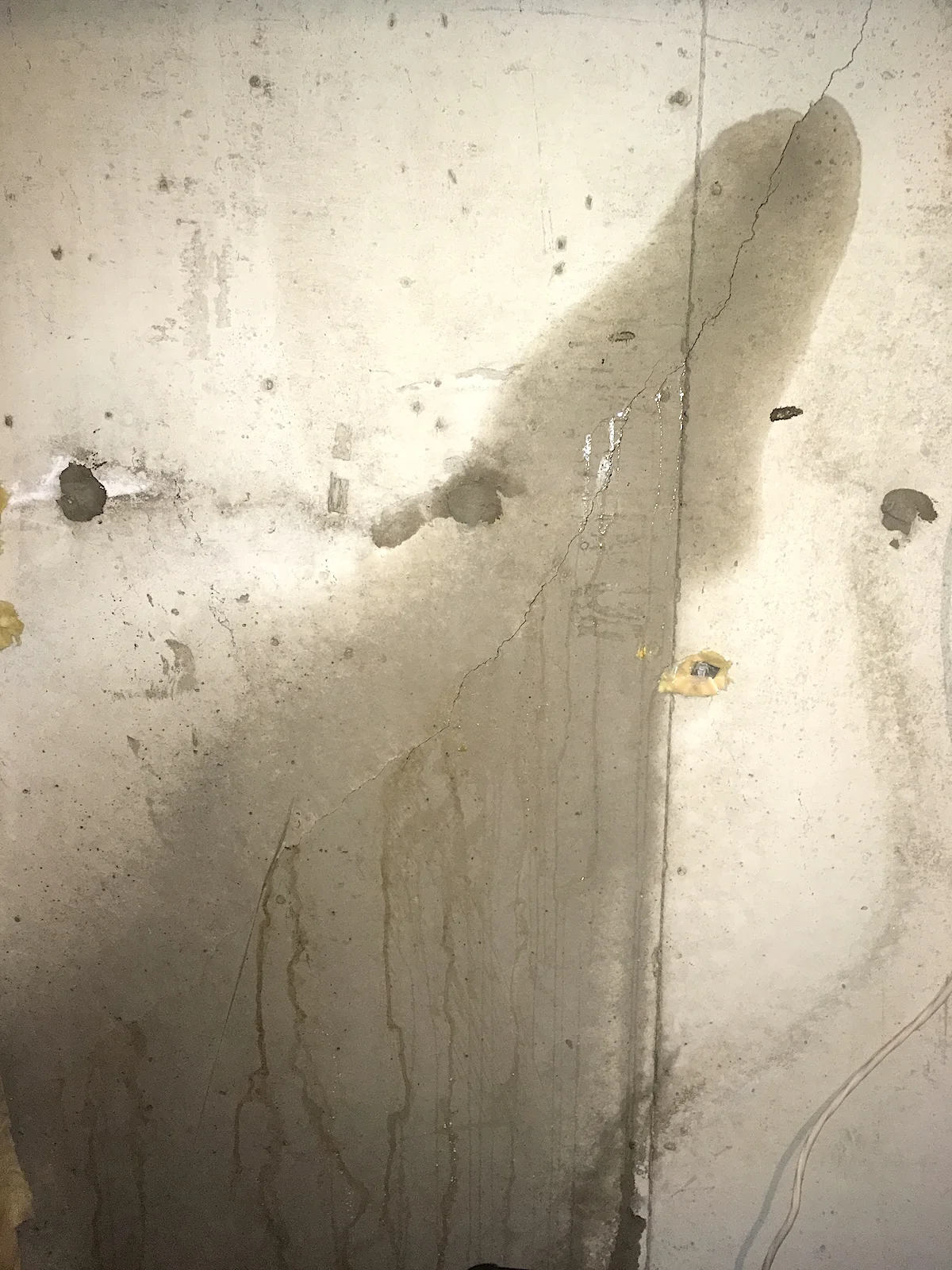
An actively leaking foundation crack allowing groundwater to enter the basement.
Crack Leakage
Which Cracks Leak and Which Do Not?
When we attend a property to investigate the source of a leak or consult on basement leak repairs, particularly before basement renovation begins, one of the most common questions homeowners ask is whether a particular foundation crack will leak or not.
Unfortunately, there is no way that anyone can honestly predict if a foundation crack will leak in the future. In our experience, the width of a crack does not determine whether water will enter the basement through it. Some foundation wall cracks will never leak and some leak regularly.
Cracks leak when these conditions exist:
- The crack extends through the wall from the inside to the outside – very few cracks do not; and
- When there is sufficient hydrostatic pressure against the exterior wall to push water through the opening/void/crack.
Even a very narrow crack can leak when there is sufficient hydrostatic pressure. In fact, from time to time we repair leaking cracks in the foundation wall in the basement that is an interior garage wall. How there can be sufficient water pressure beneath the garage floor to cause a crack to leak is somewhat of a mystery, although water tables do rise and fall with precipitation levels. Notably, on more than one occasion we have fixed invisible foundation cracks. What? Yes, there were water droplets on the wall and when injected, the expanding polyurethane traced a visible path. They were extremely fine cracks invisible to the naked eye.
The bottom line is this: a crack is a long, thin hole in the foundation wall. If sufficient pressure exists on the other side, water will push through and enter the basement. The reason that the basement is leaking is the presence of a hole in the wall (the crack) with water pressure behind it, if the hole is eliminated, the leak disappears.
Cracks That May Never Leak
Some cracks remain dry for years while some never leak. This does not necessarily mean a crack has been sealed or repaired or that it will never leak. It simply means that groundwater conditions have not yet created enough pressure to force water through the crack.
Many homeowners discover this after unusually heavy rainfall, rapid snowmelt, or changes in grading and drainage around the home. When hydrostatic pressure against a foundation rises dramatically, deficiencies in the foundation reveal themselves first as puddles of water on the basement floor.
Why Cracks Suddenly Begin Leaking
A foundation crack that has remained dry for years can begin leaking unexpectedly.
In this situation, the crack itself may not have changed at all; instead, the amount of water and pressure outside the wall has increased to the point where groundwater is forcing its way through.
Water Does Not Always Appear Where the Crack is
One of the most confounding aspects of basement leak diagnosis is that water sometimes travels some distance before it pools and becomes visible on a basement floor. This phenomenon makes finding a leak in a finished basement challenging at times.
We have found that in most cases, water pools on the basement floor in close proximity to where the foundation is leaking. However, groundwater entering through a foundation crack may travel behind finished walls along framing members before becoming visible some distance away from the crack. Note: this does not occur very often.
As a result, the visible wet area inside your basement may not accurately identify the location of the actual crack.
The Important Takeaway About Crack Leakage
All foundation cracks have the potential to leak, and the absence of visible water today does not guarantee the crack will remain dry in the future.
For this reason, if you are contemplating finishing your basement you must closely inspect your foundation walls for leak staining and ideally flood the exterior walls to check if visible cracks would leak when exposed to significant hydrostatic pressure.
Signs a Foundation Crack Needs Repair
In discussing foundation crack repair, it is important to distinguish between cracks that need to be repaired because they are leaking and cracks that need to be repaired because the foundation has moved/settled/shifted.
Leak repairs are considered basement waterproofing repairs while crack repairs for other reasons typically involve reinforcing crack locations. There are of course extreme situations that demand comprehensive structural foundation repair; that is beyond the scope of this guide.
Not every foundation crack requires immediate action. The following warning signs suggest that repair should be considered sooner rather than later.
Water Seepage
The most obvious sign that a crack requires repair is the presence of water, which is usually confirmed by the presence of staining on the foundation wall, and/or floor, at the crack location.
The presence of water is confirmed by:
- Visible active leaking;
- Puddles on the floor after heavy rains of snow melts;
- Dampness along the crack (dark concrete);
- Mud staining on the foundation wall;
- Efflorescence deposits (white powdery appearance); and
- Interior damage.
When there is evidence that a crack has leaked you should expect that the crack will leak again sometime in the future.
Increasing Crack Width
Cracks that appear to be widening over time deserve prompt attention.
Increasing width may indicate ongoing settlement, structural loading issues, or other forms of foundation movement.
Monitoring crack width over time helps determine whether movement is ongoing. There are monitoring devices that can be installed to track foundation crack widening over time.
Repeated Seasonal Leakage
Some cracks leak regularly during certain seasons. Most notably during the spring when snow melts, accompanied by heavy rains.
Cracks seldom leak during hot and dry summer months unless irrigation systems are maintaining high groundwater levels.
Interior Damage
Foundation cracks can cause damage beyond the concrete wall itself. Common signs include wet drywall, stained baseboards, damaged flooring, mold growth, musty odours, and deterioration of stored belongings.
In finished basements, the visible damage often understates the extent of the leak because water may travel behind walls before becoming visible. As a result, even a relatively small foundation crack can cause extensive concealed damage over time.
Structural Warning Signs
Certain conditions may suggest that further investigation is warranted.
Examples include:
- Horizontal cracks;
- Significant crack widening or cracks wider than 6mm;
- Wall bowing;
- Multiple large cracks;
- Criss-crossing cracks;
- Doors or windows that suddenly become difficult to open and close; and
- Excessive foundation settlement (drywall cracking on the main and/or second floor and/or step-cracking in the exterior brick veneer).
These conditions do not automatically mean major structural repairs are required, but they must not be ignored and should be reviewed by a civil engineer.
The Cost of Delaying Repairs
Many homeowners postpone foundation crack repairs because they expect that the repairs will be too costly. Sometimes, repairs are delayed because cracks appear to be minor or the associated leak is not causing a problem.
Unfortunately, water infiltration issues do not resolve themselves on their own. Delaying repairs can result in:
- Increased interior damage to finishings and furniture and effects;
- Mold growth and associated adverse health consequences;
- Higher repair costs and additional basement finishing expenses;
- More extensive corrective work; and
- Foundation concrete damage and deterioration.
Identifying and repairing foundation cracks early is usually the most cost-effective approach to take.
Once a crack has been identified and evaluated, the next step is understanding the repair options available and how they differ.
Foundation Crack Repair Options
Once a foundation crack has been identified, the next step is selecting the appropriate repair method.
Not all repair methods accomplish the same objective. Some methods are designed to stop water infiltration, while others are intended to restore structural integrity or reinforce the foundation wall.
Selecting the most effective and appropriate crack repair method depends on:
- The type/form of crack;
- Whether the crack is leaking;
- The width of the crack;
- The orientation of the crack (vertical/diagonal/criss-crossing);
- The condition of the foundation wall (clean or spalling);
- The accessibility of the crack to perform the repair;
- The urgency of the repair;
- Your budget for crack repairs;
- Weather conditions; and
- Whether structural concerns exist.
The most common foundation crack repairs are as follows:
Surface Patching
Surface patching involves applying hydraulic cement, caulking, mortar, or similar materials over the visible portion of a crack.
While surface repairs may temporarily reduce leakage, they do not address the full depth of the crack.
Because water pressure continually pushes against the outside surface of the foundation wall, many surface repairs eventually fail, because water finds a pathway around the patch. Surface patching is only recommended if a major foundation leak is discovered outside of normal business hours, to slow down the leak until a professional injection repair can be completed.
A major negative for this repair approach is that patching over the inside surface of a leaking foundation crack traps water within the crack/wall. This water is absorbed by the concrete which subsequently reduces the compressive strength of the concrete wall.
Exterior Excavation and Waterproofing
Exterior waterproofing involves excavating the soil beside the foundation wall to expose the crack from the outside.
This type of repair typically includes:
- Excavation of the foundation at the crack location down to the footing (at the base of the foundation wall);
- Exterior crack repair with cement;
- The application of an elastomeric rubber foundation coating over the crack repair (or a self-adhering rubber membrane); and
- The installation of foundation wrap on top of the coating.
Exterior waterproofing is most appropriate for block foundations, widespread foundation leakage, deteriorated exterior foundation walls, or situations where excavation is already required for other reasons, such as inadequate interior accessibility.
Most leaking poured concrete foundation cracks are repairable from inside the basement without excavating around your home; the process is known as crack injection.
Crack Injection
Crack injection is one of the most widely used repair methods for leaking poured concrete foundation cracks. The process involves filling the full depth of the crack, from the inside to the outside, under pressure.
Importantly, a properly performed crack injection addresses the entire crack through the entire thickness of the wall rather than merely covering the crack surface.
Crack injection is performed using polyurethane or epoxy resins, depending on the characteristics of the crack.
Crack Stabilization
In situations where crack widening and crack growth are of concern, foundation cracks are often stabilized with carbon fiber staples or stitches to prevent the crack from opening wider.
Carbon Fibre Crack Stabilization Explained
Once a crack in concrete has been repaired, further crack widening could lead to repair failure. This risk is mitigated by stabilizing the crack so that the two sides of the crack cannot move further apart. This is particularly important when dealing with diagonal settlement cracking and when a crack is the result of movement within the foundation wall.
Foundation cracks can be stabilized using metal straps, but more commonly, foundation cracks are stabilized using carbon fiber stitches (formerly staples). Carbon fiber stitches are extremely light and 2 – 4 times stronger than steel and certainly stronger than the concrete itself.
The carbon fiber stitches are inserted into the foundation wall, perpendicular to the crack. The stitches bond to the concrete via a structural epoxy paste.
The inserted carbon fiber stitch resists the tension applied to it by the two sides of a crack attempting to move apart. Carbon fiber stitches are essential in restraining movement of concrete cracks.
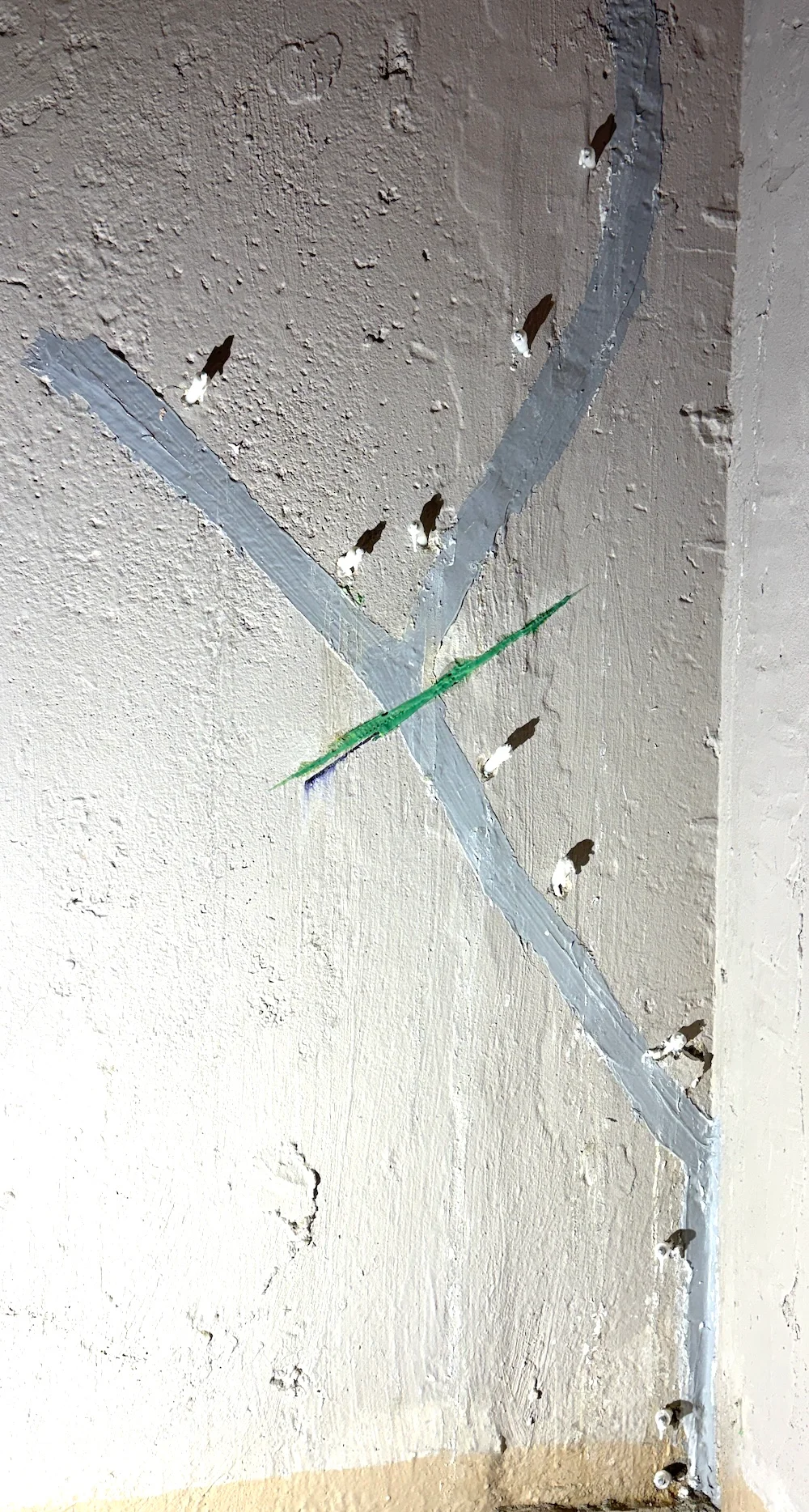
The green line marks a carbon fibre stitch installed across a repaired foundation crack. Carbon fibre stitches help stabilize cracks and resist future widening caused by foundation movement.
Choosing the Right Repair
The goal in foundation crack repair is long-term, reliable problem resolution. It should not be selecting the least expensive repair without regard to the long-term adverse impacts on your concrete – as is the case with surface patching. Similarly, waterproofing an entire foundation wall to fix a single leak is cost inefficient, unless you are intent on waterproofing the entire wall.
The importance of undeniably identifying the precise source of a basement leak cannot be understated. Without visibly witnessing a crack and/or staining on an interior foundation wall it is not possible to be 100% certain of the cause of the water in a basement. Making assumptions concerning how water is entering your basement often leads to repairs being performed that do not resolve the problem. Often, homeowners agree to having repairs performed that, in time, are deemed to have been a waste of money. A classic example of this is plumbing leaks – many foundations are waterproofed externally when the proper solution was the hiring of a plumber.
It is imperative that the repair method entirely resolve the problem in question, and reliably.
Understanding crack injection is important because it has become one of the most common repair methods for leaking poured concrete foundation cracks.
Crack Injection Explained
What is crack injection?
Crack injection is a repair process used to fill and seal cracks in poured concrete. Conceptually, if you eliminate the foundation crack / void you eliminate the basement leak.
Unlike surface patching, crack injection addresses the foundation crack through the entire foundation thickness by introducing repair material directly into the void under pressure.
How Crack Injection Works
The exact procedure varies based on the repair material being used, and whether it is a low pressure or a high-pressure injection.
For low pressure injections, injection ports (T-ports) are installed along the crack, and an epoxy paste is applied over the interior face of the crack to secure the ports and confine the injected material within the crack.
High pressure injections are performed using injection packers (plastic or metal) which are hammered into channels drilled through the foundation crack on an angle from the side of the crack.
Injection material is then introduced through the ports/packers under pressure. For low pressure injections a dispensing gun is used, while high pressure injections use electric pumps, and sometimes grease guns.
The objective is to completely fill the crack from the inside face of the wall to the soil outside.
When the crack is filled, there is no longer a path available for water to enter your basement through the crack.
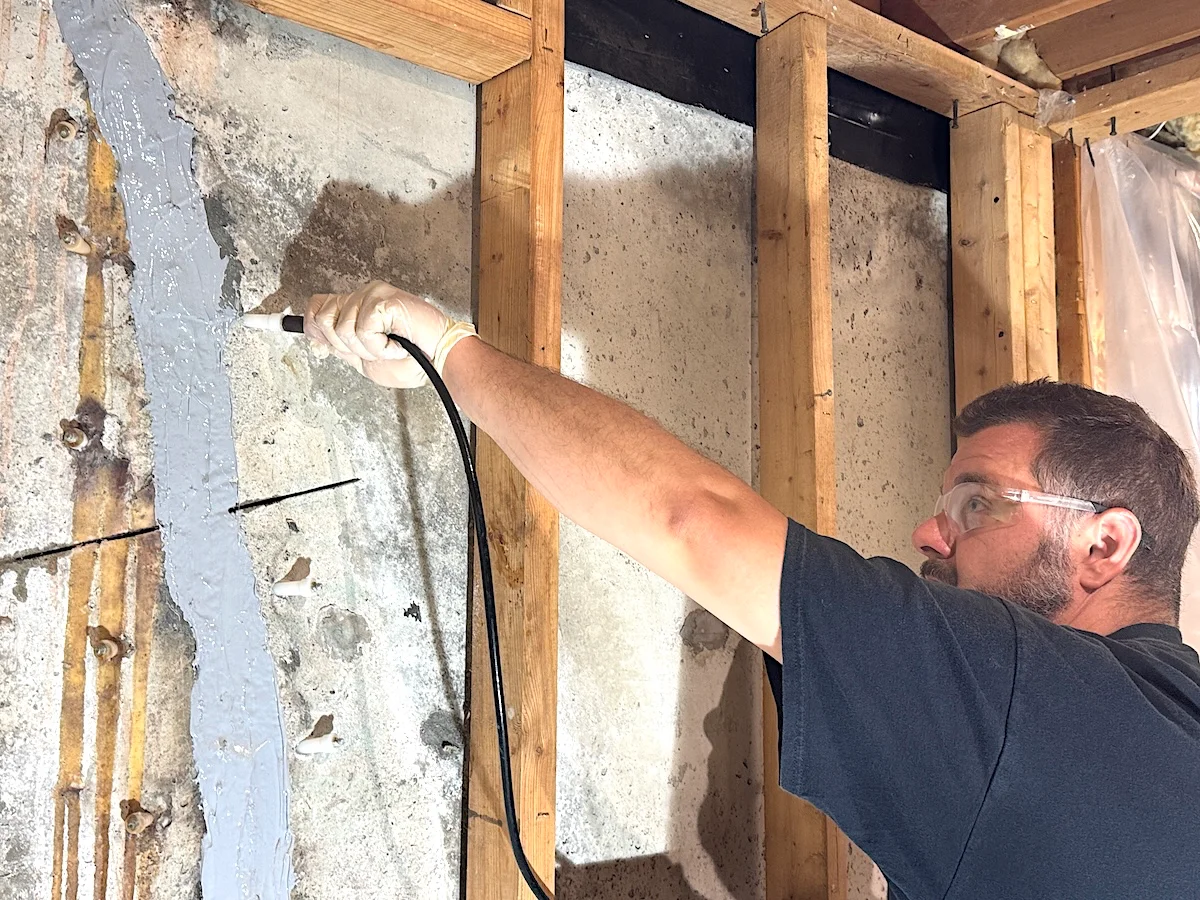
Polyurethane crack injection in progress. Injection packers are installed along the crack and repair material is injected under pressure to fill the crack through the full thickness of the foundation wall.
Injection Materials
Concrete foundation crack injections are performed using two materials: polyurethane, and/or epoxy.
Each material has different characteristics and is used for different purposes. Understanding those differences is important when evaluating repair recommendations.
Injection Quality Considerations
A successful crack injection depends on multiple factors beyond the actual injection of material into the crack.
Factors critical to a successful crack injection include:
- Technician experience;
- Material selection – polyurethane or epoxy;
- Crack preparation prior to injection;
- Injection pressure;
- Complete crack penetration and filling of the void; and
- Crack stabilization, if required.
These considerations are also reflected in current technical guidance from the International Concrete Repair Institute (ICRI), which emphasizes the importance of properly assessing the crack and site conditions, selecting an appropriate grout, and relying on experienced personnel to make appropriate decisions during the injection process.
The injection materials used by waterproofing contractors are produced by established chemical manufacturers and are only one component of a successful repair. In our experience, the quality of the crack injection process and the experience of the technician performing the work have a major influence on long-term repair performance.
Polyurethane Crack Injection Explained
Polyurethane injection is one of the most common methods used to repair leaking poured concrete foundation cracks, and fissures and voids in concrete generally.
The use of polyurethane grout for controlling water leakage through cracks in concrete is also addressed in current technical guidance published by the International Concrete Repair Institute (ICRI). Polyurethane leak grouts are particularly well suited to water-control applications because they can penetrate fine cracks and fissures and react within the crack to help form a water-resistant seal.
The process involves injecting a specially formulated polyurethane resin into the crack under pressure.
How Polyurethane Works
As polyurethane enters the crack, it follows the same pathways previously used by water to enter your basement, the path of least resistance.
The material enters the crack in the form of a liquid resin as viscous as thick syrup and expands into a flexible foam as it reacts to moisture within the crack. The force associated with the expansion of the polyurethane is significant and one of polyurethane’s most desirable properties. This powerful expansion of the polyurethane foam ensures that all irregularities, voids, and small pathways within and around the crack are filled.
Once cured, the polyurethane provides a flexible seal that prevents water infiltration.
High-pressure Polyurethane Crack Injection Step-by-step
- A water and phosphoric acid blend is injected into the crack with the purpose of cleaning out any debris including mud and minerals and to slightly widen the crack to create a fully open void for the polyurethane resin to travel thoroughly and fill the crack entirely.
- Clean water is then injected into the crack to flush out the acid and any remaining debris.
- Polyurethane resin is injected under high pressure into the crack, entering in the form of a liquid with the consistency of syrup and expands into foam when encountering the water of the previous step.
- As the polyurethane travels through the crack, it seeks out the pathways previously used by water filling every void through its expansion.
The importance of crack cleanliness is also recognized in technical guidance from the International Concrete Repair Institute (ICRI). The Institute notes that contaminants and accumulated debris within cracks can interfere with grout performance and that water alone may not always be sufficient to clean accumulated material from crack surfaces.
The objective is complete filling of the crack through the full thickness and height of the foundation wall, which is ensured by injecting resin into the crack until the crack will no longer accept any material.
Confirmation of Repair Success
Experienced technicians continually monitor the repair during each stage of the injection process. For example, the crack is not subjected to pressurized injection before the epoxy paste has cured. The technician verifies that the drilling was good enough to ensure that each injection packer allows material to be injected into the crack. That the acid travels freely within the crack and adjusting injection pressures as required and confirming that the crack is completely full.
The goal is to confirm that the crack has been filled and stabilized if required.
Final Steps in the Repair
After the crack injection is complete, as much excess polyurethane as possible will be scraped from the crack’s surface leaving only the packers, epoxy paste and a minimal amount of residual polyurethane visible.
The foundation crack has now been sealed internally without excavation.
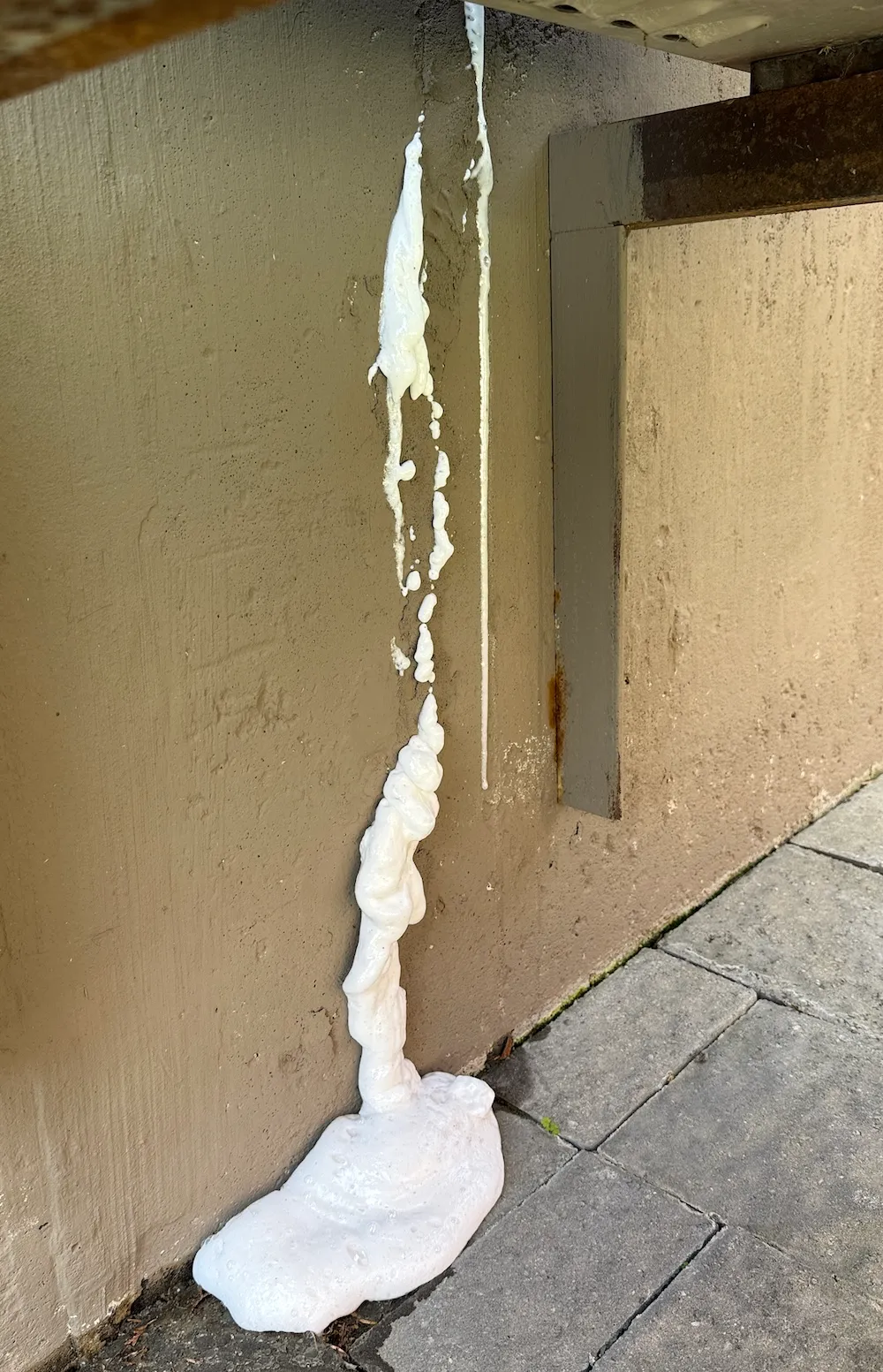
Polyurethane visible on the exterior side of a foundation wall after injection. The appearance of polyurethane outside the wall confirms that the material has penetrated through the full thickness of the foundation crack.
Why Polyurethane Is Used Worldwide
Polyurethane possesses several significant attributes for the repair of leaking foundation cracks:
- Excellent water sealing properties;
- Ability to penetrate very narrow openings;
- Flexibility after curing;
- It is the only material suitable for injection in wet/damp and previously repaired foundation cracks;
- It is suitable for filling large cavities such as pipe penetrations, tie-rod holes and honeycombing (visible aggregate);
- Injected polyurethane cures very rapidly (10-15 minutes); and
- It is performed from inside the home, avoiding the need for excavation.
These characteristics make polyurethane particularly well suited for repairing active water leaks in poured concrete foundation walls.
Current technical guidance from the International Concrete Repair Institute (ICRI) similarly identifies polyurethane leak grouts as materials used for controlling water leakage through concrete cracks and notes characteristics including their ability to penetrate fine cracks and fissures, rapid reaction and adhesive qualities.
The Criticality of Full Polyurethane Crack Penetration
The objective of polyurethane injection is not simply to fill a portion of the crack but to achieve complete penetration through the full thickness of the foundation wall, from the bottom at the footing to the top of the wall.
If portions of the crack remain unfilled, water may continue to find pathways into the basement. This is why technician experience and the injection process are crucial for a successful repair.
The Crack Injection Advantage
Many homeowners are surprised to learn that most leaking poured concrete foundation cracks can be repaired from inside the basement.
The advantages of interior basement leak repair are:
- No excavation and disruption to landscaping, garden beds, walkways, air conditioning units, fences and decks;
- Fast completion: foundation crack repairs are completed within a few hours;
- Lower overall cost: crack injections are far less costly than external basement waterproofing repairs that need to consider reconstruction and remediation of landscaping; and
- It is easy to confirm that a crack injection has been successful.
While not every poured concrete foundation leak problem can be solved from inside the basement, polyurethane injection has become the preferred repair method for most leaking poured concrete foundation cracks.
What Types of Cracks Can Be Repaired with Polyurethane?
Polyurethane injection is a suitable repair for most leaking cracks found in poured concrete foundation walls.
Common examples include:
- Vertical shrinkage cracks;
- Settlement-related cracks;
- Fine hairline cracks;
- Actively leaking cracks;
- Previously repaired cracks that have begun leaking again; and
- Cracks concealed behind finished basement walls.
Polyurethane is particularly effective because it can penetrate extremely narrow openings and expand to fill voids within the concrete.
In addition to foundation cracks, polyurethane is commonly used to seal leaking pipe penetrations, tie-rod holes, honeycombing, and other voids in poured concrete structures.
What Polyurethane Injection Cannot Fix
Although polyurethane injection is an excellent waterproofing solution, it is important to understand that it is not suitable for cracks wider than 4mm and has other limitations:
Polyurethane injection does not:
- Stop foundation settlement.
- Straighten bowed foundation walls.
- Correct structural deficiencies.
- Prevent future cracks from developing elsewhere in the foundation; and
- Replace structural reinforcement where reinforcement is required.
When significant structural movement is present, additional measures such as carbon fibre reinforcement, steel bracing, or engineering solutions may be necessary.
For this reason, proper diagnosis is critical before any repair method is selected.
What Homeowners Should Expect After Repair
Polyurethane crack injection repairs are completed in a single visit and do not require a return appointment.
Once the repair is complete, homeowners should expect to see evidence of the repair on the interior side of the foundation wall. This includes the surface epoxy paste used during the injection process, injection packers, and small amounts of cured polyurethane foam that may have escaped from the crack during injection. Excess polyurethane on the interior wall is typically scraped away as part of the repair process to improve appearance.
In many cases, polyurethane will also emerge from the exterior side of the crack above ground level. This is a positive indication that the polyurethane has penetrated through the full thickness of the foundation wall. Any visible polyurethane that emerges on the exterior can be trimmed or removed after it has fully cured.
The injection packers are not removed immediately after the repair. Polyurethane within the crack remains fluid for a period of time after injection, and removing the packers could allow material to escape through the injection channels and potentially compromise the repair. For this reason, the packers are left in place.
The epoxy paste used during the injection process can be painted if desired. However, in many unfinished basements the repair area is hidden behind insulation or future finishing materials, so painting is usually unnecessary.
Once the repair is complete, the basement can generally be returned to normal use immediately. If drywall or finished wall materials were removed to access the crack, those repairs should not be completed until the homeowner is satisfied that all sources of water infiltration have been addressed; a hose test of the exterior wall is recommended. This simple test can help identify any additional water entry points that may exist nearby, such as leaking tie-rod holes, pipe penetrations, window wells, or other foundation defects. Confirming that all water entry points have been addressed before closing the wall helps avoid costly future repairs.
Why Polyurethane Has Become the Preferred Repair Method for Leaking Poured Concrete Foundation Cracks
Over the past several decades, polyurethane injection has become one of the most widely used methods for repairing leaking poured concrete foundation cracks.
Its popularity is largely due to the following attributes:
- It immediately stops active water infiltration;
- Polyurethane injection is a low-cost waterproofing method;
- It penetrates extremely fine cracks.
- It accommodates minor future movement.
- It is performed from inside the basement without regard to weather conditions; and
- The need for excavation is eliminated in most situations.
While no single repair method is appropriate for every situation, polyurethane injection has proven to be a highly effective solution for most leaking poured concrete foundation cracks encountered in residential construction.
The long-term success of the repair depends not only on the material selected but also on proper diagnosis, complete crack penetration, and the quality of the work performed.
Comparison of Epoxy & Polyurethane Injection
Homeowners are often presented with two primary crack injection options: epoxy and polyurethane. While both materials are effective there is much to consider when comparing them as crack repair options.
Epoxy Injection
Epoxy is a rigid structural adhesive.
When injected into a crack under appropriate conditions, epoxy bonds the two sides of the crack together. Epoxy is often used when structural bonding is the primary objective.
Polyurethane Injection
Polyurethane is primarily a water-stopping material.
Rather than creating a rigid bond, polyurethane forms a flexible seal within the crack. This flexibility helps accommodate minor future movement while maintaining resistance to water infiltration.
How the Two Injection Methods Compare
When you compare an epoxy crack injection to a polyurethane crack injection, you need to consider three different aspects: the material characteristics, the injection processes; and the limitations associated with both the material and the process.
Comparison of Material Characteristics
In comparing the material characteristics of epoxy and polyurethane resins there are significant differences between the two.
Epoxy is essentially a glue that will bond the two sides of a crack together with a bond strength that exceeds the strength of the concrete itself; this is viewed as a structural repair and the main reason epoxy crack injections are promoted as being superior to polyurethane crack injections. One major limitation of epoxy is it’s inability to adhere to wet surfaces; therefore, it is not suitable for actively leaking or wet/damp foundation cracks. Epoxy resins are available in several viscosities such that there are thin epoxies for fine cracks and thicker epoxies for thicker cracks.
Polyurethane resin has no such bond strength, but it’s expansion characteristics are very useful in filling voids generally but also voids beyond the visible crack. In addition, polyurethane is the optimal material to use when dealing with leaking or wet concrete cracks.
The Injection Processes
Both the epoxy crack injection and the polyurethane crack injection can be accomplished using the low-pressure injection technique. However, polyurethane injections can also be done using high pressure injection.
The injection process is so important that we believe the process is more important to the success of a crack repair than the material properties. The reason for this is unrelated to the amount of pressure used to inject the resins.
Low Pressure Injection
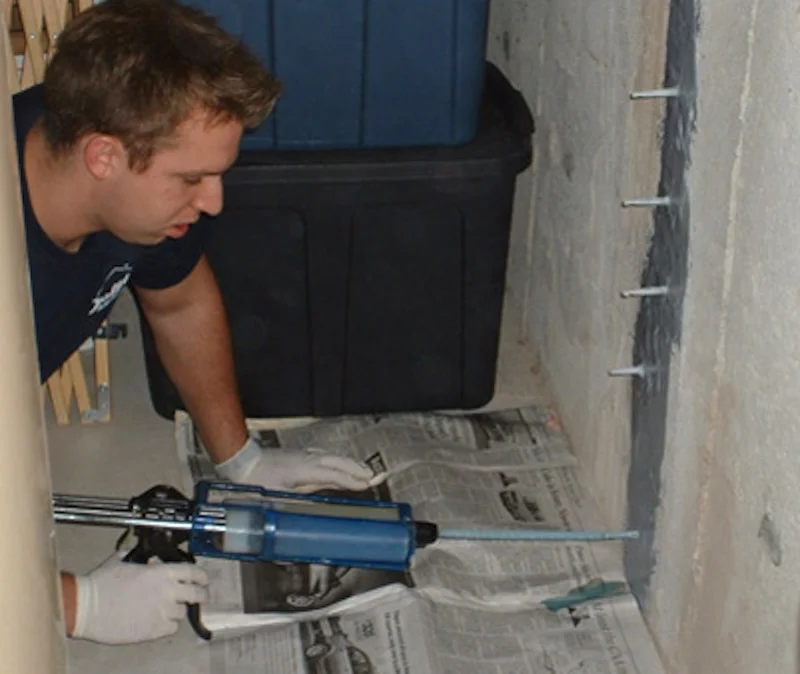
A low-pressure crack injection being performed using surface-mounted T-ports and a dispensing gun. Low-pressure injection can be used with either epoxy or polyurethane resin.
A low-pressure injection uses a dispensing gun to dispense either epoxy or polyurethane resin into a foundation crack. The pressure of the dispensed resin ensures that the resin will travel through the entire thickness of the wall. Problems arise when cracks are extremely fine, previously filled with resin, full of mud, and full of minerals. In these instances, which is probably more than 50% of the time, rinsing the inside of the crack with acid is crucial to the success of the injection repair.
The value of the acid rinse must not be understated. The acid rinse of the crack accomplishes several things:
- It widens very fine cracks, ensuring that the thicker resin will flow freely within the crack;
- It dissolves and ejects accumulated mud and minerals within the crack; and
- During acid rinsing there is confirmation that the resin will flow satisfactorily within the crack.
An acid rinse is followed by a water flush which further cleans out the crack.
The low-pressure injection does not include an acid rinse, so it is possible that a crack is simply impossible to fill completely, or at all, when a crack is very fine.
Another weakness of the low-pressure injection is the reliance on the bond strength of the T-ports. The T-ports through which both polyurethane and epoxy are injected at low pressure are bonded to the surface of the crack with an epoxy paste. When the T-ports are subjected to considerable pressure, for example when a very fine crack is injected, the T-ports will often detach (blowout) from the crack, rendering further injection impossible.
High Pressure Injection
High pressure injections are carried out using polyurethane resin only and the process is completely different than the low-pressure injection process.
Because polyurethane is dispensed at very high pressure when using this injection process, the T-ports used for low pressure injection are not suitable. Instead, injection packers are hammered into the wall so that high injection pressures can be applied. It is through these injection packers that acid, water and polyurethane are injected into the foundation crack.
It is interesting to note that relatively low injection pressures are needed for high-pressure injection because the crack has been acid flushed, thus ensuring that injection resins flow well within the crack. Some contractors use metal mechanical injection packers to be able to inject cracks with extremely high pressures. These high pressures often create additional cracking around the injection packer and increase the risk of splashing or spraying resin in your basement.
It should be noted that the use of metal mechanical packers suggests that extreme pressures are necessary because the crack has not been acid flushed and polyurethane must be forced into the crack.
Which Injection Option is Best?
Neither material is universally better.
We have already established that epoxy is favored for strong bonding repairs of cracks while polyurethane is great at filling cracks and all the other voids around them. You would think that in choosing crack repairs you simply decide if you want to fill the crack or bond the crack with great strength; herein lies the problem with epoxy.
When a foundation crack leaks water into your basement you have clear evidence that the crack is open on both sides of the foundation wall. Since the injection process involves filling the crack under pressure it is important to note that the injected material also exits the crack to the outside. Since the injected material travels through the foundation wall, will there be enough material left in the crack so that it is completely full? This is where cure time of the injection material factors into our choice of injection process and material.
Epoxy resin cures in 3-5 hours at 77° Fahrenheit; if the crack is filled to the top and can drain out of the crack to the outside for 3-5 hours, how much of the crack is still filled after that amount of time?
Polyurethane reacts to moisture and cures very quickly. In fact, if the crack is very wet the polyurethane begins to cure on contact with the water. Within 15 minutes polyurethane foam is pretty much at maximum volume. Once the polyurethane is solid within the crack it can no longer be lost to the outside.
Since we offer a 25-year warranty on our foundation crack injections we have chosen the high-pressure polyurethane crack injection to be our injection repair of choice. A high-pressure polyurethane injection is the most versatile foundation crack repair available; done properly it is also reliable. Here are some of the key reasons for our choice:
- High-pressure polyurethane crack injection can be done whether the crack is wet or dry;
- The polyurethane can be used in both hot and cold conditions;
- This repair method can be used for wide and narrow cracks, previously repaired cracks and even when the precise location of the crack can’t be determined (when someone has tarred over it to try to fix it);
- If we need bond strength we can reinforce the crack with carbon fiber stitches; and
- High-pressure polyurethane injection can be used in tight spots where a dispensing gun would not fit.
Understanding repair methods is important, but homeowners are also understandably concerned about cost. The next section examines the factors that influence foundation crack repair pricing.
Foundation Crack Repair Costs
One of the first questions homeowners ask is, “How much will the foundation crack repair cost?”
Unfortunately, there is no single answer because repair costs vary depending on the type of crack, the repair method selected, site conditions, and whether structural concerns are present. This doesn’t mean that the repair costs alot, it means that there is a price range for foundation crack repairs and final pricing is influenced by several factors.
Factors That Influence Cost
The most important factors affecting repair costs include:
- Crack length;
- Crack width;
- Ease of access;
- Whether the basement is finished;
- Number of cracks requiring repair;
- Repair method selected; and
- Whether crack stabilization is required.
A simple vertical shrinkage crack will cost less to repair than a large crack associated with significant structural movement.
Why the Lowest Price Is Not Always the Best Value
A foundation crack repair should not be viewed as a commodity service as crack injection processes can vary considerably.
Two waterproofing contractors may propose similar repairs at very different prices, yet the quality of workmanship, warranty coverage, repair procedures, and long-term performance may differ substantially.
Homeowners should understand that the quality of the injection is of paramount importance. The injection process varies between vendors as does the experience level and training of the technicians. Low cost offerings almost certainly guarantee that the amount of material used to effect the repair will be limited and the skill and experience of the technician is also likely to be limited.
Frequently Asked Questions
Are foundation cracks normal?
Foundation cracks in the vast majority of homes in Southern Ontario result from normal concrete shrinkage and settlement. Every crack should be evaluated to determine whether water infiltration or structural concerns are present.
Can a hairline foundation crack leak?
Yes. Even very narrow cracks can allow water to enter when groundwater pressure exists against the exterior foundation wall.
Do all foundation cracks require excavation?
No. The majority of poured concrete foundation cracks can be repaired from inside the basement using professional crack injection techniques.
Is a leaking foundation crack a structural problem?
Not necessarily. Many leaking cracks are non-structural. However, the crack should be evaluated to determine whether movement or structural concerns exist.
How long does foundation crack repair take?
Most standard crack injection repairs can be completed in a single visit of a few hours. The excavation and waterproofing of a crack takes one day.
Will the crack leak again after it is repaired?
A properly repaired crack is unlikely to leak in the future. The quality of the repair, stabilization and complete crack penetration are critical to long-term performance.
What causes a crack that never leaked before to suddenly begin leaking?
Rising groundwater levels, heavy rainfall, snowmelt, drainage problems, and hydrostatic pressure can all cause a previously dry crack to begin leaking.
How much does foundation crack repair cost?
Costs vary depending on the type of crack, repair method, accessibility, and site conditions. A professional assessment is usually required to determine the appropriate repair approach.
Can cracks behind finished basement walls be repaired?
Yes. In most cases, foundation cracks behind finished walls can be accessed and repaired using high-pressure polyurethane crack injection.
Should I repair a crack that is not currently leaking?
The answer depends on the type of crack, its location, evidence of movement, and the likelihood of future leakage. Many homeowners choose to repair cracks before water infiltration occurs, particularly when they are considering finishing their basement.
Conclusion
Foundation cracks are a common reality of home ownership. Some develop as concrete cures and shrinks, while others result from settlement, frost movement, construction conditions, or structural loading.
Although not every crack represents a structural concern, every crack deserves proper evaluation. Even fine cracks can become pathways for water infiltration when groundwater pressure is high enough against the foundation.
Understanding the type of crack, the cause of the crack, and the available repair options allows homeowners to make informed decisions and avoid unnecessary repairs.
For many poured concrete foundation walls, professional polyurethane crack injection provides an effective method of permanently stopping water infiltration without excavation.
The key to successful foundation crack repair is accurate diagnosis, appropriate repair selection, and complete treatment of the crack itself rather than simply covering the visible symptoms.
If you have discovered a foundation crack or are experiencing basement leakage, addressing the problem early is often the most effective way to protect your home and avoid more extensive repairs in the future.
Learn more about AquaGuard’s foundation crack repair and polyurethane injection service, including how we assess leaking cracks, repair options, pricing and warranty coverage.
Need Help With a Foundation Crack?
Most leaking poured concrete foundation cracks can be repaired from inside the basement without excavation.
Contact AquaGuard Injection & Waterproofing for an assessment.