Epoxy crack injection (also referred to as epoxy injection) is an extremely effective and reliable concrete crack repair method, used exclusively for the repair of poured concrete foundation cracks, for the structural repair of same, to fix basement leaks, and to prevent poured concrete foundation cracks from leaking in the future. When used under the right conditions and when done properly by a trained injection technician, an epoxy concrete crack repair does not fail.
Civil engineers commonly recommend epoxy concrete crack injection for the structural repair of cracked concrete in applications such as highway overpasses and overhead concrete structures; this is due to epoxy’s significant bond strength. While epoxy crack injections are not as versatile as polyurethane crack injections, for example, the repair of actively leaking cracks contributing to a wet basement, the use of epoxy is nonetheless a very effective means of repairing concrete cracks and preventing potential basement leaks. With this crack repair method you accomplish several objectives at the same time: you are waterproofing your basement, you are structurally repairing a foundation crack, and you are preventing the possibility of a future basement leak from the repaired crack.
Does epoxy crack injection actually work?
With so much information published on the internet anyone doing research on epoxy injections will encounter contradictory opinions as to whether or not this type of repair actually works. Yes it does and fortunately, there are credible sources of information on the internet that confirm this. The American Concrete Institute www.concrete.org has published a bulletin on this subject specifically; click on this hyperlink to view their document entitled “Field Guide to Concrete Repair Application Procedures“.
How an epoxy crack injection repair is done
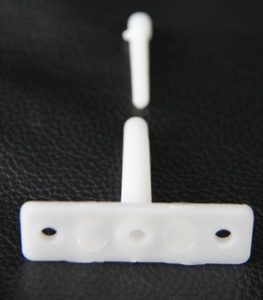
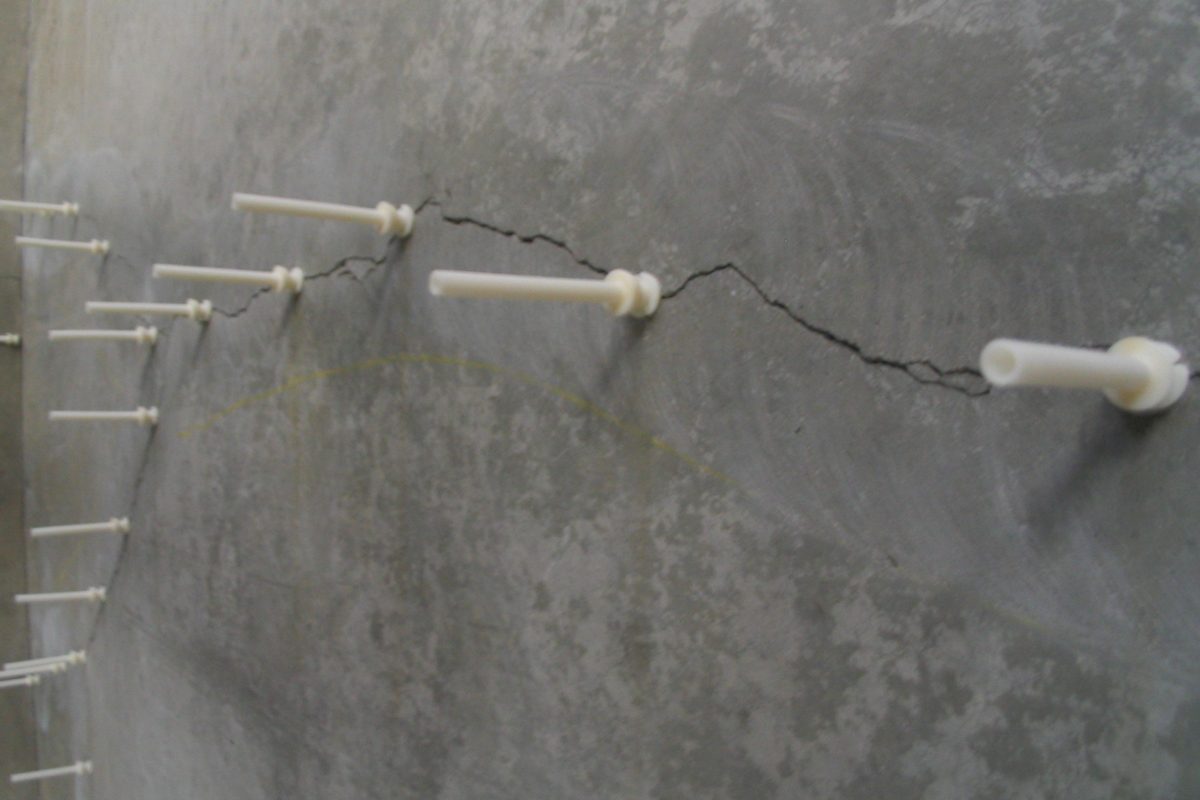
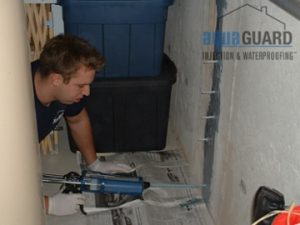
This type of injection is performed from inside your basement, thus avoiding the need for excavating your foundation. The injection is a low pressure (less than 450 psi) injection of epoxy resin through injection ports installed along the length of the crack. These ports adhere to the wall by using an anchoring epoxy paste. This paste is applied over the entire length of the foundation crack and, in conjunction with the soil outside, serves as a barrier to confine the epoxy within the foundation crack so that the injected epoxy is contained over the entire length of the crack.
The injected epoxy typically cures within 5 hours and bonds the two sides of the crack together in addition to filling the crack through the entire thickness of the foundation wall (typically 8″), thereby sealing the crack permanently because the crack essentially no longer exists; this is the ultimate concrete crack repair. In fact, the bond strength of epoxy exceeds the strength of the concrete itself! There is no drilling involved with low pressure crack injection and odors are not noticeable. Epoxy if often the preferred crack repair material because it is a structural repair.
How a crack is prepared for epoxy injection
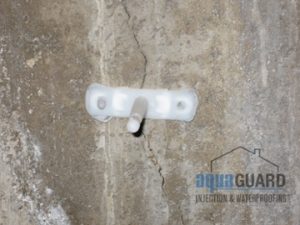
During this step, the injection technician will gain access to the foundation crack from inside the basement. Subsequently, the injection ports will be installed, and the crack will be covered over with the epoxy paste. Crack preparation for an epoxy crack injection typically takes 30 minutes.
The epoxy paste must be allowed to cure for approximately 30 minutes, depending on the temperature and relative humidity in the basement, before the second step (the actual epoxy crack injection) can begin. Failure to allow the paste to fully cure may result in an incomplete injection of the crack. It should be noted that the paste (anchoring epoxy) will not adhere well (if at all) to a wet surface; consequently, the bond strength will be insufficient. Without a strong bond, the epoxy paste will not be able to withstand the injection pressure; therefore, an epoxy injection is only a viable crack repair option when the wall surface is completely dry.
Injection of the concrete crack with epoxy
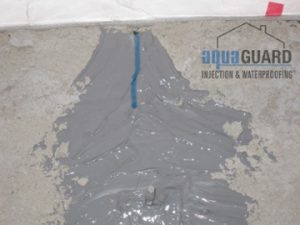
It is during this step that epoxy resin is injected into the foundation crack. The time required to inject a crack varies with the width of the crack, the viscosity (thickness) of the epoxy used, and generally takes 15 – 45 minutes per crack. As a result of our extensive experience in performing epoxy crack injections, AquaGuard Injection & Waterproofing® uses epoxies with differing viscosities as dictated by the characteristics of the concrete crack being injected; this is required in order to prevent the epoxy from bleeding through the crack into the soil on the outside during the curing process, which takes several hours. The technician begins the epoxy crack injection through the lowest injection port until epoxy travels up the crack and becomes visible in the injection port immediately above it; then the lowest injection port is capped-off and epoxy is injected into the port immediately above it. This process is repeated until the injected epoxy is seen exiting the crack at the top of the foundation, or until the crack has been filled up to grade.
Note: Several technical factors need to be taken into account to determine whether a concrete crack should be injected using epoxy or polyurethane resin. Only our trained technicians can determine which injection is most suitable for any given foundation crack. As stated previously, epoxy crack injection is not as versatile as polyurethane crack injection; therefore, not all cracks can be properly injected using epoxy resin. For more information read our companion article comparing the epoxy and polyurethane crack injection processes.
Tip: On completion of an injection, if you wish to test the effectiveness of the repair using a garden hose, you must wait at least 24 hours after the injection has been completed so as to not interfere with the curing of the epoxy within the crack.